
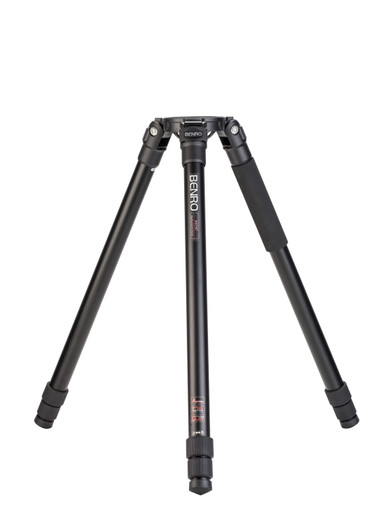
Your needs, this model
Does it fit your priorities?
Is the A474T a complete head kit?
No. This is tripod-only A474T with 100 mm bowl; a compatible head is a separate choice. Do not confuse it with a different A474T/BV10 kit or C474T carbon-fiber sibling.
Explore this need in the finder →Does it meet a 150 cm height request?
Benro and B&H list 150.5 cm maximum. That clears a 150 cm support threshold, but the head and camera determine final viewfinder height.
Explore this need in the finder →Is it inside a 66 cm folded limit and 4.4 kg carry cap?
Both sources list 66 cm closed. Benro says 2.86 kg while B&H says 4.4 kg; use the larger figure for a strict carry cap until the exact unit is confirmed.
Explore this need in the finder →The A474T is a legs-only video tripod with a 100 mm bowl, not a supplied video-head kit. Benro’s exact page describes three-section aluminum single-tube legs, independently selectable leg angles, half-turn twist locks, replaceable rubber feet and included spikes. Its table lists a 15.5 cm minimum, 150.5 cm maximum, 66 cm closed length, 35 kg payload and 2.86 kg product weight. B&H confirms the exact A474T MFR and agrees on the bowl, height range, fold and rating, but reports a much heavier 4.4 kg.
Use the leg positions and bowl as actual selection criteria
Each leg has three independent position stops and can be adjusted in length, which is a different setup from a tripod whose spreader alone sets the leg opening. The legs do not need a separate spreader according to B&H. This may be useful when a floor, step or outdoor position makes an even three-foot plane difficult, but the product page does not promise safe placement or grip on every surface. The rubber feet can be removed and replaced by spikes for softer ground, and the leg sections can be taken apart for cleaning after grit or rough conditions.
The 100 mm metal bowl is the key interface to plan around. A compatible head must be chosen separately, with the plate, camera screws, leveling arrangement and operating range checked as one system. Do not assume that a 75 mm head or a flat-base head is interchangeable without the appropriate adapter. The 35 kg published payload is not an independent stability test and does not tell you what head to choose or whether an off-center rig is suitable.
A material weight conflict changes strict carry decisions
For this exact model, B&H lists 4.4 kg while Benro’s table says 2.86 kg. Those numbers differ too much to smooth into one figure. The fit screen uses 4.4 kg so a strict carry-cap match will not rely on the lower maker number; confirm the current exact-model weight if a few kilograms matter to your workflow. The maximum and minimum heights match at about 150.5 cm and 15.5 cm, and both pages list 66 cm closed length. The support maximum is not your camera viewfinder height, and the folded specification does not prove that it will fit a particular case or trunk partition.
Benro lists a carrying case and spikes, but a seller’s box should still be checked for those parts, the exact leg SKU and a compatible head if it is being sold as part of a larger package. This review concerns A474T alone; it is not the C474T carbon-fiber sibling or another tripod/head combination with a similar model stem.
Who should shortlist the A474T?
It is a source-backed option for a buyer who already expects to select a separate 100 mm head and values the single-tube layout, 15.5 cm low position and adjustable legs more than an included kit. It is less attractive where the carry weight must be known exactly, where a complete head package is required, or where a shorter folded form matters. No hands-on setup, leg-lock feel, load, stability or height testing was performed for this assessment.
The 66 cm closed figure and the maker/retailer weight conflict have different practical meanings: the first is a support-length specification, not an interior luggage measurement, while the latter is significant enough to change a 4.3 kg carry filter. The conservative 4.4 kg value screens that stricter request out until an exact current unit is checked. Its 150.5 cm listed maximum clears a 150 cm support threshold but does not establish an eye-level result with a particular camera and head.
Sources: Benro’s exact A474T product page and B&H’s exact-MFR A474T listing. The conflicting product-weight figures are retained above.
Key specifications
Key details at a glance
| Listed support or kit weight | 4.4 kg |
|---|---|
| Leg material | Aluminum |
| Maximum height (as listed) | 150.5 cm |
| Minimum height | 15.5 cm |
| Closed length | 66 cm |
| Leg sections | 3 |
| Leg-lock style | Twist locks |
| Head supplied with tripod legs | No |
| Upper head attachment | 100 mm metal bowl; no head included |
| Spreader position | Three independent leg-angle stops; no separate spreader |
Use the exact model’s instructions for operating limits, supplied equipment and version differences.
Sources for this review
Sources for this assessment

Make the choice fit your whole camera setup
Start with your head, camera and lens, then use the published figures as screening limits rather than field-performance claims.