
Your needs, this model
Does it fit your priorities?
Does HH75AV meet the selected head-package requirement?
No. HH75AV is the headless 75 mm hi-hat; the BL75 half-ball is optional, not a supplied video head.
Explore this need in the finder →Does 28 cm published working maximum meet a 28 cm support-height floor?
Yes for the conservative 28 cm exact-model field; a 29 cm floor is not cleared. This is support height, not camera-eye height.
Explore this need in the finder →Does the exact 23 cm closed length and 1.3 kg package weight fit a strict carry screen?
It passes at 23 cm folded and 1.3 kg, but fails the 22 cm fold or 1.2 kg weight cap. The head and camera still need to be included when estimating the complete carry system.
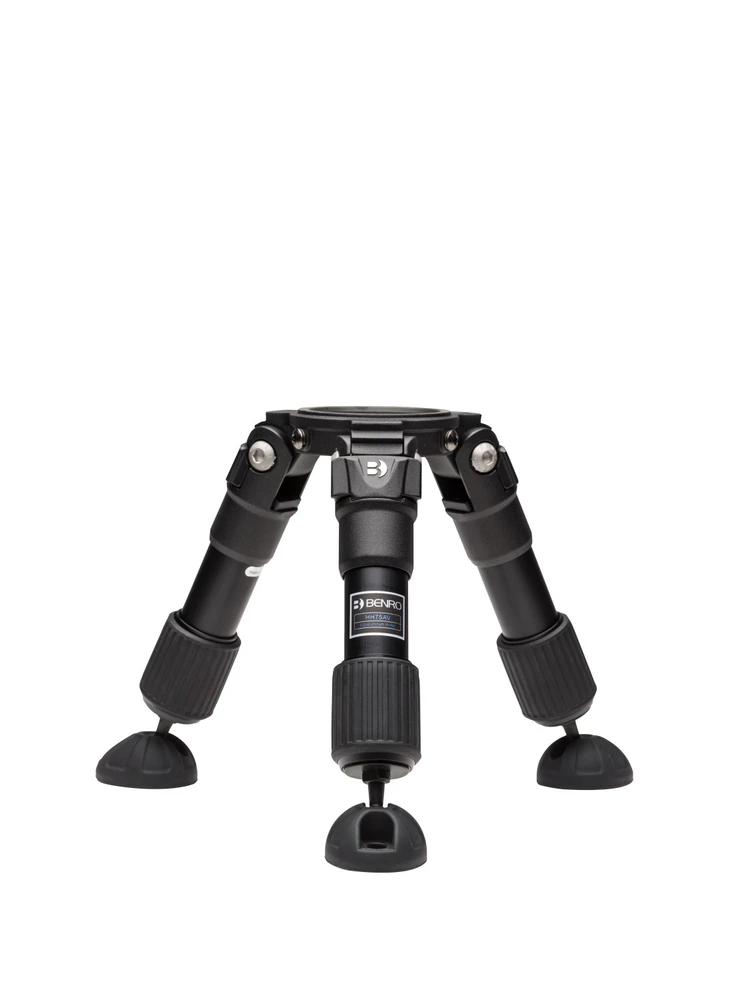
Explore this need in the finder →The Benro HH75AV is a low-profile video tripod support for floor-level angles, stairs and tight shooting spaces. Its exact U.S. product page specifies a 75 mm bowl, two telescoping leg sections and three independent leg-angle stops. The tripod does not include a video head. Its 75 mm interface is the defining difference from the related HH100AV, not a cosmetic variation.
Choose it only for a 75 mm head system
Benro says the HH75AV accepts a 75 mm video head and includes a 3/8-16 low-profile tie-down adapter for a low mounting arrangement. A BL75 half-ball adapter can be added to mount an appropriate 3/8-16 flat-base video or photo head, but that adapter is not in the listed package. Check the head's base diameter, tie-down and camera plate before buying; a 100 mm head does not fit merely because the larger HH100AV is nearby in the catalog.Independent legs and selectable feet
The short aluminum legs telescope and use large twist-lever locks. Each can be placed at one of three stops, so a low support can be arranged around a step or a small floor area. Benro lists movable-joint rubber feet, classic rubber feet and spikes, a carrying case, and pre-drilled foot holes for attachment to a board. These are possible mounting and contact arrangements, not proof that a particular stair, board or surface can safely carry a camera rig. Confirm that the feet are correctly fitted and that any board attachment is appropriate for the actual load.Understand its published range
Benro lists an 8 cm minimum height and a 28 cm maximum, with 23 cm closed length and 1.3 kg product weight. The 75 kg maximum payload is a manufacturer rating. It is not a measured stability result and does not account for the selected head, camera, lens, cables, accessory arms or a high off-center load. The listed dimensions describe the support only; the camera's position and head add height and mass.HH75AV versus HH100AV
The two Hi-Hats share the low camera-placement role, two telescoping sections, three leg-angle stops and a 23 cm closed length. The HH75AV has the 75 mm bowl, an 8 cm published minimum and 1.3 kg weight; the HH100AV uses a 100 mm bowl, lists a 7.5 cm minimum and 1.6 kg weight. Benro also lists different maximum payload ratings. Those figures do not make the units interchangeable or certify that either will be stable with every rig. Start with the head interface already in the kit room and then check the actual support and surface.Evidence and checks
The exact Benro U.S. model page provides the HH75AV SKU, specifications and package contents; the consulted current manual index did not list the code. This is only a manual-index limitation. No hands-on setup or load testing is claimed. Before ordering, confirm that the exact 75 mm model—not HH100AV—is in the box, whether the chosen head or half-ball adapter is separate, which rubber or spike feet are supplied, and whether the mounting arrangement is safe for the planned surface. The photograph shows the exact low support without a head.Make the low position part of the rig plan
The HH75AV's listed height is measured at the support, not at the camera sensor or viewfinder. A tall head, quick-release plate and camera may place the lens higher than expected, while a compact tie-down arrangement can put it closer to the floor. Map the complete head and camera assembly before deciding whether the 8 cm minimum is enough. If a low shot must clear a stair edge, rail or nearby object, measure the complete arrangement and verify that no leg or camera body will be obstructed at the chosen angle.Source: Benro HH75AV product information.
Key specifications
Key details at a glance
| Listed support or kit weight | 1.3 kg |
|---|---|
| Leg material | Aluminum |
| Maximum height (as listed) | 28 cm |
| Minimum height | 8 cm |
| Closed length | 23 cm |
| Leg sections | 2 |
| Leg-lock style | Twist locks |
| Head supplied with tripod legs | No |
| Upper head attachment | 75 mm bowl with included 3/8-16 low-profile tie-down adapter; bl75 half-ball is optional, not included. |
| Carrying bag included | Yes |
Use the exact model’s instructions for operating limits, supplied equipment and version differences.
Sources for this review
Sources for this assessment

Make the choice fit your whole camera setup
Start with your head, camera and lens, then use the published figures as screening limits rather than field-performance claims.