
Your needs, this model
Does it fit your priorities?
Does the KH26PC include a fluid video head rather than just tripod legs?
Yes. The exact model is sold as a video-head tripod kit, and the exact-MFR US listing classifies the included head as a fluid head. The 60 mm bowl and included plate are part of this kit; verify whether the seller's box is the KH26PC head-and-tripod package rather than a dolly bundle.
Explore this need in the finder →Does the published maximum reach at least 184 cm?
Benro lists 184.5 cm maximum for KH26PC, so it meets a 184 cm listed-support threshold. This is the tripod height, not a camera's viewfinder position, and it says nothing about stability at full extension.
Explore this need in the finder →Can the tripod fit a 91 cm folded-length limit and a 4 kg product-weight ceiling?
The exact maker table lists 91 cm closed and 4 kg product weight, so it reaches those published limits exactly. A carry case, camera, lens and accessories add to the complete load, and the dimensions do not guarantee room inside a particular bag.
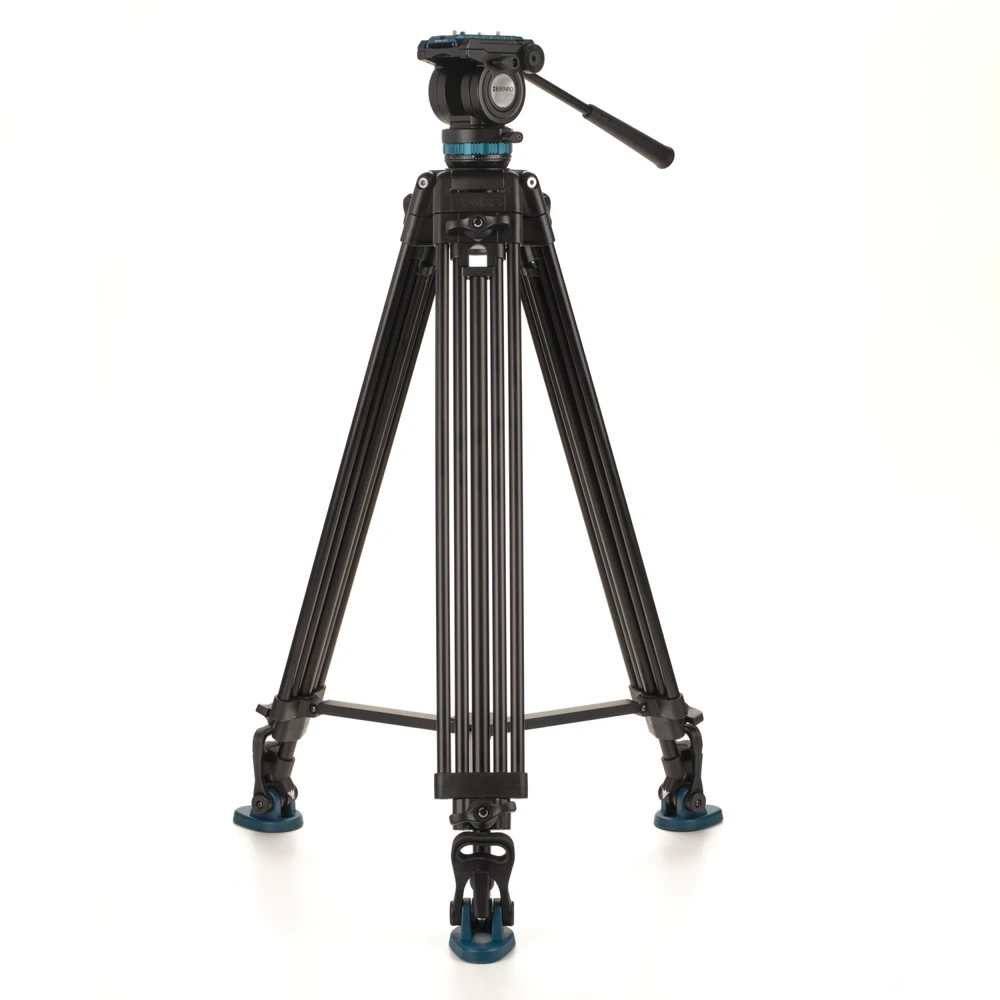
Explore this need in the finder →The KH26PC is a full-size aluminum video kit for a camera operator who wants the head and tripod legs in one box. Its useful distinction is not simply that it reaches high: it pairs a 60 mm leveling bowl with a three-section, two-stage leg set and an included video head. The exact Benro page lists a 184.5 cm maximum and a 6.8 kg payload, but those are manufacturer specifications, not a stability test with a particular camera, lens, monitor or counterbalance setting.
A tall support with a long folded profile
Benro lists 87.5 cm as the minimum and 184.5 cm as the maximum support height. That high end can reduce how often a standing operator stoops, but it is not the final viewfinder height: the camera plate, body, eyepiece and the operator's posture change that position. At the other end, 87.5 cm is not a low-angle setup. If the frame needs a near-ground viewpoint, this is the wrong geometry to assume from its tall maximum.
The exact table gives a 91 cm closed length and a 4 kg product weight. These numbers matter more than the two-stage description if the tripod must fit in a car, case or checked bag. The included carry case is useful for transport, but no source measures its usable interior length. Camera, lens, plate and accessories also add to the weight carried; the listed 4 kg belongs to the tripod kit rather than a complete camera-ready rig.
The legs are aluminum, with twist-lock adjustment and three sections. A two-stage arrangement gives the operator two groups of leg extension to set, while the mid-level spreader links the legs above the feet. That can suit a controlled video setup but makes the deployed footprint and spreader an important part of the placement check. The tripod is not a horizontal-column stills system: its head sits in a 60 mm bowl.
The included head and plate need exact checking
Benro describes an included video head, a leveling bowl, a reversible pan handle and a plate compatible with the 501 format. B&H's exact-MFR US listing classifies the head as a fluid head and describes a QR15C plate. The maker's own material is less internally tidy: its overview says the head provides continuous pan drag, whereas the specification table labels pan and tilt drag fixed; the overview names QR15C while a technical row says QR11. Those details should not be silently reconciled into a promise of variable fluid drag or an interchangeable plate family. Verify the exact head controls, plate code and safety-pin fit against the camera or cage you intend to mount.
The maker lists a 6.8 kg payload. That ceiling does not show how a front-heavy camera behaves at full extension, and it cannot substitute for balancing the camera on the plate or checking that tilt counterbalance suits the rig. If the camera is substantially lighter than the rating, a head can still feel poorly balanced; if it is near the maximum, add-on accessories count toward the load. The rating is an upper published limit, not evidence of a particular movement quality.
How it differs from the neighboring KH kits
KH26PC is not interchangeable with KH25PC just because both share a head family. KH25PC has a lower 156.5 cm listed maximum and a 79 cm closed length; KH26PC reaches 184.5 cm but closes to 91 cm and weighs more. The added reach costs a larger packed profile. The older KH26P is also a separate model: Benro says KH26PC replaced it, with the newer model's maker-listed 15 lb rating rather than the earlier 11 lb figure. Do not use an old suffix-free listing or used seller photo as proof of the C version's plate or package.
Who should shortlist it—and what to confirm
Put the KH26PC on a shortlist when the required system includes a video head, a leveling bowl, a pan handle and a reach above what compact travel tripods offer. Look elsewhere when a shorter folded bundle, lower minimum height, removable or selectable head, or a well-documented drag range is essential. The long folded dimension and whole-kit mass make it a poor fit for a light hiking carry, regardless of its aluminum construction.
Before ordering, confirm that the exact box is KH26PC head and legs rather than a separately assembled dolly bundle; check whether the included plate is QR15C or another listed interface; verify pan and tilt drag controls on the particular generation; and test the camera's clearance, balance and plate retention before operating. Benro's consulted U.S. manual index did not show a KH26PC entry, so this assessment does not borrow setup procedures from a different head or tripod. No hands-on movement test, load test, packed-case measurement or claim about seller stock is being made.
Key specifications
Key details at a glance
| Listed support or kit weight | 4 kg |
|---|---|
| Leg material | Aluminum |
| Maximum height (as listed) | 184.5 cm |
| Minimum height | 87.5 cm |
| Closed length | 91 cm |
| Leg sections | 3 |
| Leg-lock style | Twist locks |
| Head supplied with tripod legs | Yes |
| Head type | Fluid video head |
| Upper head attachment | 60 mm leveling bowl |
| Carrying bag included | Yes |
Use the exact model’s instructions for operating limits, supplied equipment and version differences.
Sources for this review
Sources for this assessment

Make the choice fit your whole camera setup
Start with your head, camera and lens, then use the published figures as screening limits rather than field-performance claims.