
Your needs, this model
Does it fit your priorities?
Can the KP1 replace a full-height tripod for a standing-height shot?
No. Benro lists a 21 cm maximum working height. The legs can be positioned flexibly, but the page does not establish a taller support mode or minimum height; plan to use a raised, sound surface if the framing point is higher.
Explore this need in the finder →Do I need to add a separate ball head to use a compatible small camera?
No separate head is listed for the exact KP1: Benro specifies an integrated ball head and a 1/4-inch top mounting thread. The head's removability, thread pitch, plate and fit with a particular camera, cage or accessory are not established.
Explore this need in the finder →Is the phone holder part of the KP1 setup, and will it fit my phone?
Benro lists a folding smartphone adapter in the exact US package and says it permits vertical or horizontal phone orientation. The source does not give clamp width or clearance for a particular phone, case or buttons; verify the exact seller box and your device before relying on the fit.
Explore this need in the finder →What should I check before wrapping the flexible legs around an object?
The maker describes gripping an object and an auxiliary lock ring, but no exact rail diameter, surface material or overhead safety limit is published. Inspect that the legs wrap without damage, the ring is installed as intended, and the complete camera or phone arrangement is secure before letting go; do not treat 1.5 kg as tested overhead capacity.
Explore this need in the finder →A flexible miniature support with a narrow job
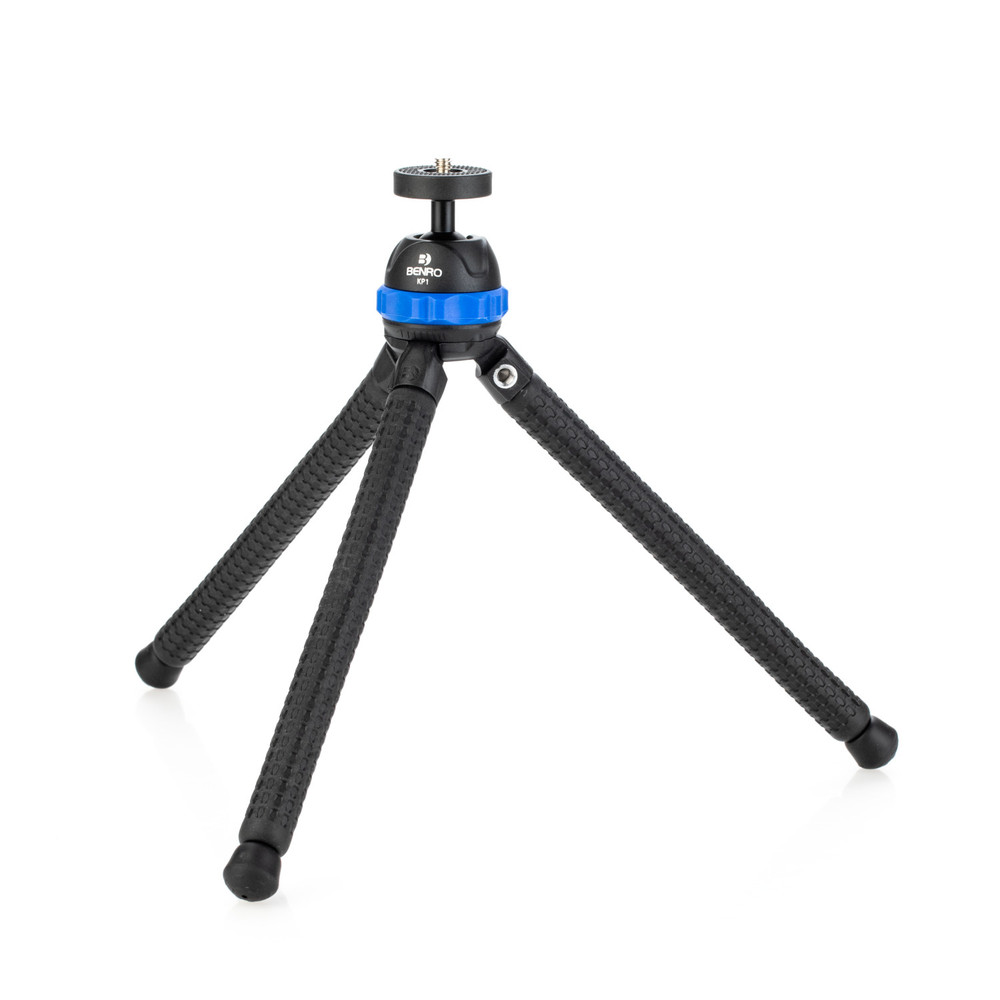
The Benro KP1 KoalaPod is not a shortened travel tripod. It is a three-legged tabletop support whose flexible legs can also be bent around a suitable nearby object. Benro's exact U.S. product page describes small compact cameras and mobile devices, and its own specification gives a maximum working height of just 21 cm. That puts KP1 in a useful but specialized range: a low desk, bench, rock or carefully chosen rail can become the camera's support point, while a standing-height viewpoint remains out of reach unless the surface itself is raised.
This is a research-based assessment of the published U.S. model information, not a report of ownership, hands-on handling or stability testing. The official catalogue card identifies SKU KP1, and the linked exact-model page lists the features and metric fields discussed here. Those entries are evidence of the product design, not a promise that a particular seller currently has stock or supplies every item mentioned in the overview.
Twenty-one centimetres is the height ceiling
Benro lists 21 cm maximum working height, 26.5 cm closed length and 0.22 kg product weight. The matching inch values are rounded conversions; no separate measurement is claimed. For a close tabletop view or a fixed phone call, the low height may be convenient. For eye-level framing, a full-size portrait setup, or a camera that needs room beneath a long lens, this is the wrong scale. The maker does not give a minimum support height, so do not treat 21 cm as the only possible framing point or as lens clearance.
The published 1.5 kg maximum load is a manufacturer rating, not an independent test of vibration, impact, wind response or safe working load. The camera or phone, case, holder and any accessory add to the assembly. A light product weight can be attractive in a small kit, but it does not establish how the tripod will behave on a slick counter, a sloping ledge or a narrow rail. Check the framing, the contact area and the complete rig before relying on it.
One integrated ball head, two device approaches
Benro describes a built-in ball head and lists “Ball Head” in the exact model specifications. It is a head-included configuration, but there is no evidence here that the head is removable or that KP1 accepts a separate quick-release plate. The manufacturer calls the top interface a 1/4-inch mounting thread; its page does not specify the pitch or describe a distinct plate. Confirm the actual camera, cage or adapter rather than treating the familiar thread diameter as proof of every accessory fit.
The same U.S. page lists a folding smartphone adapter and says it can hold a phone vertically or horizontally. That makes the KP1 a more complete phone option than a leg set that requires a separate holder, but no clamp-width range or phone-and-case clearance is published. Buttons, camera bumps, a thick case or an off-center phone can change fit and balance. Verify the adapter in the specific seller's box and check the device before choosing a framing angle. Phone support and a small camera on the top thread are alternative mounting arrangements, not a promise that both can be mounted together.
Flexible legs are not a conventional lock system
The model's distinctive choice is the bendable three-leg design. On a tabletop, that offers more ways to place the feet than a fixed mini tripod; around a suitable object, the legs can be shaped to grip a different support point. Benro also describes an auxiliary locking ring intended to help with object-mounted positioning, a quick-lock clamp for keeping the legs together, three accessory mounts and optional leg extensions. Those are useful design clues, but the U.S. page does not publish a maximum object diameter, a surface-specific grip guarantee or a test protocol for an overhead arrangement.
It is also important not to translate “quick lock” into flip locks or twist locks. The page does not identify either familiar leg-lock style. Nor is the added locking ring evidence of a camera safety tether. If using the wrap-around mode, inspect the actual object for shape, finish and damage, follow current instructions, and confirm the legs remain secured before releasing your hand. Do not mount it over people or fragile gear on the strength of the 1.5 kg rating alone.
Check the exact package rather than assuming every part
There is a small documentation wrinkle in Benro's own page: the overview says the standalone KoalaPod includes the quick-lock clamp, auxiliary locking ring and drawstring bag, while the shorter “Item Includes” list names the tripod, three legs and smartphone adapter. Both descriptions refer to the exact KP1 page, but the list is not identical. If a clamp, ring or carry bag is important to your setup, ask the seller to confirm the box for the exact SKU. The included-phone-holder statement is useful, yet it does not supply an exact device fit measurement.
The material field is similarly worth reading precisely. Benro labels the legs “Aluminum+Rubber” and describes the legs and feet as flexible rubber. This assessment retains the maker's composite wording; it does not claim the whole leg is solid aluminum or identify which layer provides the structure. Its single section is a product specification, not a count of separate parts a user can adjust like telescoping tripod legs.
How it differs from a conventional tabletop kit
Within Benro's small-support family, KP1's most meaningful distinction is its bendable legs and included phone adapter. The PP1 PocketPod is a different small reference with an integrated ball head and a much shorter listed 13.5 cm maximum, but its documented legs are a fixed, short tabletop stance rather than KP1's flexible arrangement. Benro's TABLEPODKIT is a carbon-fiber tabletop kit listed at 19.3 cm maximum and carries a separate Arca-type camera plate and phone holder; those are different interface and package choices. The comparison is about documented configuration, not a claim that one model is more stable or better built.
Who should consider the KP1?
Shortlist it when a very low support is acceptable, you want the option of bending three legs around a suitable object, and the integrated ball head plus listed smartphone adapter match your device plan. Its 21 cm maximum and 26.5 cm closed length make the scale easy to understand before purchase; the light 0.22 kg figure describes the product, not a phone-ready carry kit. The flexible construction is a real difference from an ordinary fixed-foot mini tripod, but it does not erase placement or load limits.
Skip it if you need an eye-level camera position, published minimum height, a named flip or twist lock, a removable head, a verified quick-release plate, exact phone-case fit or tested overhead support. The consulted Benro U.S. manuals index has no KP1 or KoalaPod entry, so this review does not borrow setup instructions from a neighboring tripod family. Ask for current instructions and written package details when buying, then verify the exact model label, included pieces and your device before use. No price, current stock state, measured performance or customer experience is asserted here.
Key specifications
Key details at a glance
| Listed support or kit weight | 0.22 kg |
|---|---|
| Leg material | Aluminum |
| Maximum height (as listed) | 21 cm |
| Closed length | 26.5 cm |
| Leg sections | 1 |
| Head supplied with tripod legs | Yes |
| Head type | Ball head |
Use the exact model’s instructions for operating limits, supplied equipment and version differences.
Sources for this review
Sources for this assessment

Make the choice fit your whole camera setup
Start with your head, camera and lens, then use the published figures as screening limits rather than field-performance claims.