
Your needs, this model
Does it fit your priorities?
Does the PP1 include a ball head, or are these legs only?
Benro describes an integrated ball head, which is part of the PP1 support rather than a separately selected head. The top is a 1/4-20 camera screw; neither a quick-release plate nor a removable head interface is established. Check the exact SKU and package before relying on extra adapters.
Explore this need in the finder →Can PP1 work when I specifically need a very low table-height stand that packs short?
The model-specific Benro table gives the PP1 a 13.5 cm maximum and 17.6 cm closed length. That fits a 13 cm minimum-height floor and 18 cm storage ceiling in the finder; it is not an eye-level/full-height tripod or a case-clearance guarantee.
Explore this need in the finder →Will the included phone adapter fit my specific phone and protective case?
The exact-MFR B&H PP1 package lists a smartphone adapter, but neither the Benro US product page nor the consulted model catalogue supplies a verified clamp-width range for it. Confirm that the actual seller supplies the adapter and check its opening, case and camera-bump clearance; no specific-phone fit is promised here.
Explore this need in the finder →A deliberately low support, not a short full-size tripod
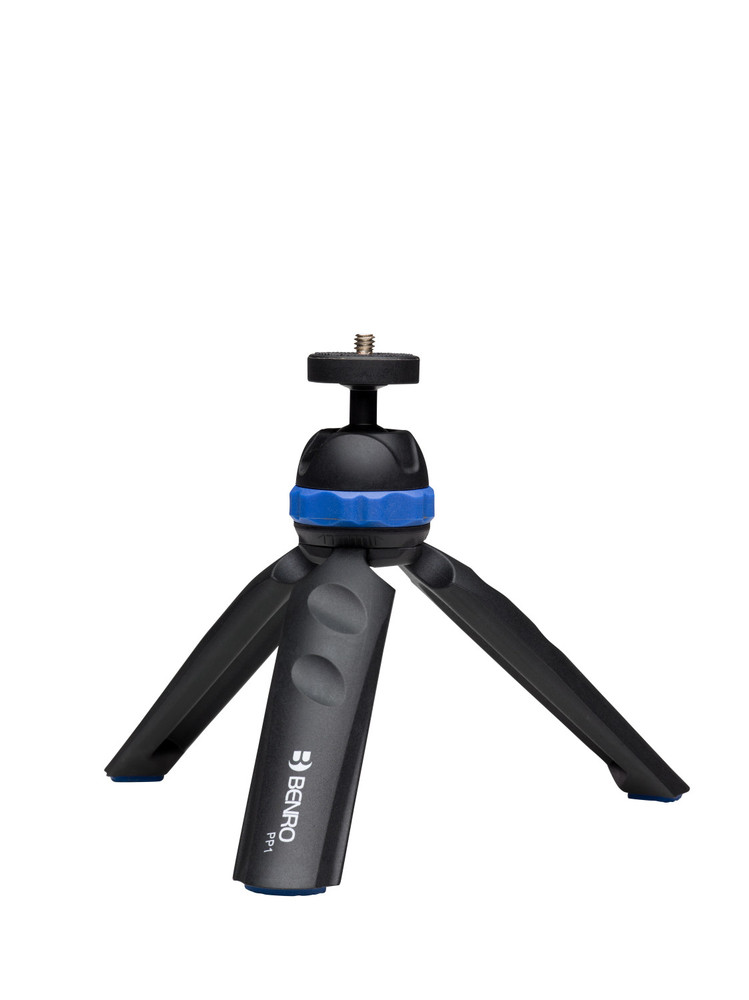
The Benro PP1 PocketPod is a specialist tabletop support. Its appeal is not reaching above a desk or replacing a travel tripod; it is putting a compatible camera close to a stable surface with very little equipment. Benro's PP1-specific table lists one leg section and a maximum height of 135 mm (5.31 in). B&H's exact-MFR listing independently describes both minimum and maximum height as 5.3 inches. That places the camera low by design. For product photography, a tabletop video call or a compact camera beside a subject, the fixed scale may be the point. For portraits standing behind a camera, landscapes from eye level or a viewpoint that changes from shot to shot, the PP1 is the wrong size of tool.
This assessment is based on the model-specific sources, not hands-on use. The height figure means the support's published top position, not the viewfinder or phone-lens height: a camera body, adapter and the photographer's framing still matter. The feet need an appropriate surface and enough room to open. The stated load rating does not prove that a particular camera/lens combination is secure or that the support will resist vibration, a bump or an uneven table.
One built-in ball head and one simple camera screw
The PP1 has an integrated ball head. Benro describes aiming from horizontal to vertical and locking the ball with a twist ring, with a 1/4-20 camera screw at the top. That can be a more useful low-angle package than legs alone when the camera needs small framing corrections. But it is not evidence of a removable head, an Arca-style clamp, a quick-release plate or a 1/4-20 tripod-base thread. Treat the supplied screw as the attachment documented for a compatible camera; verify the actual body's thread and any adapter or cage you plan to use.
Benro's description also names phones, action cameras and DSLR cameras among possible uses. The exact U.S. Benro page does not list an included-items section for this SKU, while B&H's exact-MFR PP1 package lists a smartphone adapter. That supports a phone option for that listing, not a clamp-width or universal phone-fit guarantee across sellers. A phone case, camera bump, side controls and lens position can interfere even if a clamp can close. Ask which adapter is in the specific box and check its usable opening before relying on a phone setup. The 1/4-20 screw is not itself a phone clamp.
Short fold, low listed weight, small tradeoffs
Benro's detailed PP1 table gives a 176 mm (6.93 in) closed length and a 0.16 kg (0.35 lb) weight. B&H lists 17.4 cm and 160 g, close but not identical. For matching, this assessment keeps the model-specific Benro values; for packing, a two-millimeter listing difference is less important than the real fit of the folded legs, head, adapter and any small case. The separate camera, phone, cable and case add to the mass you carry.
There is a more material source inconsistency worth noticing. The Benro product overview gives 5.6 oz, and the product-specific table says 0.16 kg, while the same U.S. page's generic dimension block calls the weight 0.38 lb / 0.2 kg. The generic block's height values also say 7.5 inches and 5 cm, which do not convert and do not match the PP1-specific 135 mm maximum. The exact-code B&H page supports the 5.3-inch working height and 160 g figure. This review therefore uses the detailed PP1 table for the finder and flags the contradictory generic fields instead of mixing them into a specification. No value here comes from our own weighing or measuring.
What the construction and load rating do—and do not—say
Benro describes the body as plastic, the feet as non-slip rubber and the ball as metal. Those details explain the intended compact design, not how it performs on glossy wood, glass, a rough ledge or a sloped surface. The maker's 1.5 kg maximum load is a published rating. It is not a tested safe working load for every camera, lens, adapter, ball angle or bump. Check that the camera stays within the rating and that the complete setup is balanced; do not assume a small footprint makes a heavy or awkward rig safe.
When the feet fold together, Benro says the PocketPod can serve as a handgrip. That is a different arrangement from the tripod stance, not an electronic stabilizer and not proof of shake reduction. It gives the small legs another handling role, but does not extend the product into a selfie stick or raised monopod. The table's single section and fixed short stance are the more relevant facts when deciding whether the tripod mode fits a job.
Who should shortlist the PP1?
Consider it when the working surface is already at the right height and the need is a very small static support, a built-in ball head and a compact pack. Its one-piece scale makes it easy to distinguish from a multi-section travel tripod, while the 1/4-20 screw keeps a documented route for compatible cameras. A phone user should separately verify the exact adapter package and clamp geometry.
Skip it if “tripod” means eye-level framing, a column, independent leg spread, flexible height, quick-release workflow or room for a long lens. The source material does not show a user-manual entry for PP1 in the consulted Benro USA manuals index, so I have not borrowed instructions from another family. The product page and catalogue disagree in some generic dimension fields, and the product page and dealer state different warranty periods; confirm the exact seller package and current written terms. The practical conclusion is narrow: PP1 is a tiny tabletop ball-head support with useful camera-thread and handgrip details, but neither an all-purpose tripod nor a tested stability solution.
Key specifications
Key details at a glance
| Listed support or kit weight | 0.16 kg |
|---|---|
| Leg material | Plastic |
| Maximum height (as listed) | 13.5 cm |
| Minimum height | 13.5 cm |
| Closed length | 17.6 cm |
| Leg sections | 1 |
| Head supplied with tripod legs | Yes |
| Head type | Ball head |
Use the exact model’s instructions for operating limits, supplied equipment and version differences.
Sources for this review
Sources for this assessment
- Benro USA Photo Tripods catalogue, page 4, card 9: PP1
- Benro PP1 PocketPod Tabletop Tripod
- Benro USA product catalogue, PP1 PocketPod, page 42 (rehosted by B&H)
- B&H exact-MFR PP1 PocketPod listing with smartphone adapter
- Benro USA user-manual index, PP1 applicability check
- Benro USA PP1 first gallery image

Make the choice fit your whole camera setup
Start with your head, camera and lens, then use the published figures as screening limits rather than field-performance claims.