
Your needs, this model
Does it fit your priorities?
Does the exact TCBC25G36PT package include a G36PT ball head?
Yes. Benro's US page names the exact TCBC25G36PT SKU and the G36PT inverted ball head, and B&H's exact-MFR listing describes the same package. The listed plate is Arca-style with a 1/4-inch camera screw and a 3/8-inch head base; check actual clamp engagement and camera/cage clearance.
Explore this need in the finder →Does its published maximum clear a 154 cm requirement, and what happens at 155 cm?
The conservative matcher uses Benro's lower 60.84-inch maximum-height entry, about 154.5 cm. It therefore passes a 154 cm listed-maximum threshold and fails at 155 cm. Benro's other fields and B&H's higher maximum disagree, so verify the current manual if that one-centimetre difference is decisive; these are not camera eye-height measurements.
Explore this need in the finder →Does the split center column document a horizontal camera position?
No horizontal position is established. Benro describes splitting the column for low-angle or macro shooting, but does not document a sideways horizontal arm or its confirmed absence. A hard yes or no answer should not be inferred from a low-angle split-column description.
Explore this need in the finder →What published travel limits does this complete tripod/head package meet?
Benro lists 47.3 cm closed and 1.163 kg for the product; B&H's exact-MFR listing reports 18.6 inches folded and rounds the weight to 2.56 lb. It fits whole-centimetre/0.1 kg questionnaire caps of 48 cm and 1.2 kg, but not 47 cm or 1.1 kg. The case, camera, lens and accessories still need separate clearance and carry allowance.
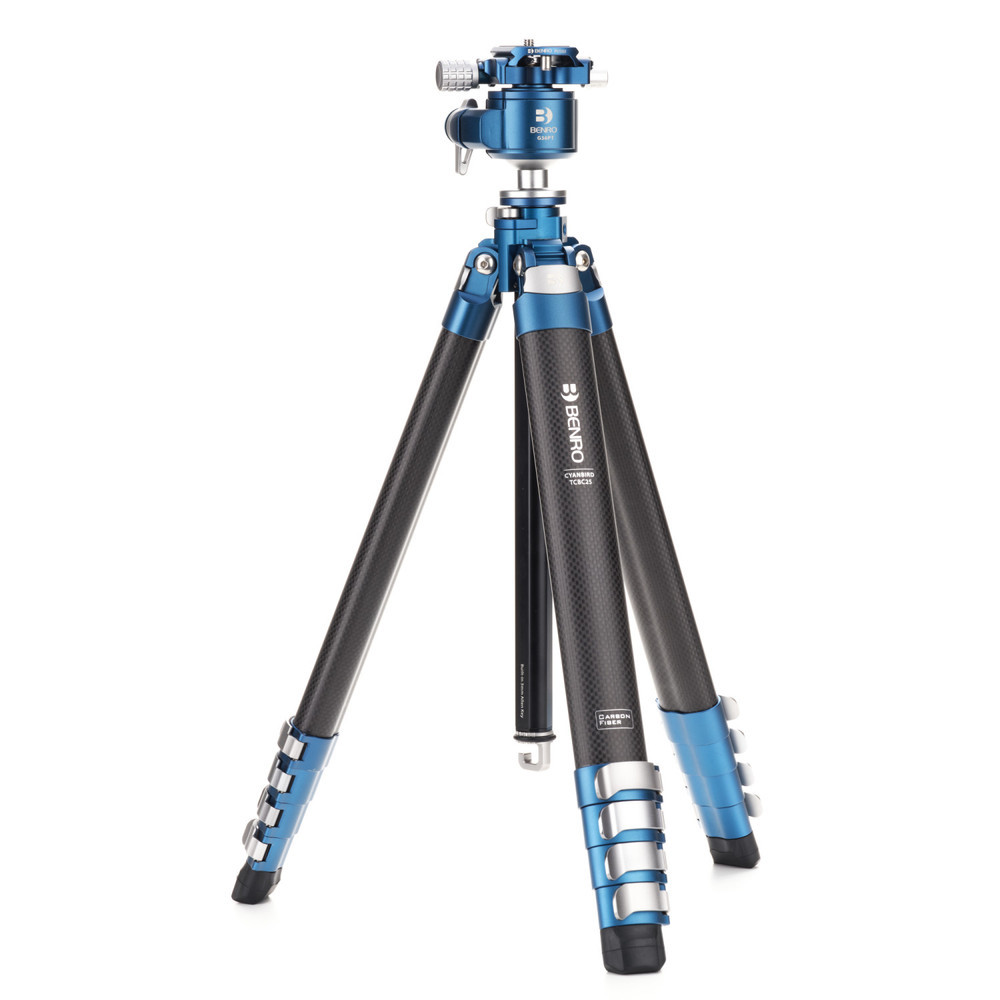
Explore this need in the finder →The TCBC25G36PT is Benro’s five-section CyanBird CF 2 carbon-fiber tripod kit with the G36PT low-profile inverted ball head already attached. The exact US manufacturer page and an exact-MFR US dealer page identify the package; this is a source-based assessment, not a hands-on test or a claim about how steady it will be with a particular camera and lens.
One defined carbon-fiber and ball-head package
The code matters. Benro’s US listing names the TCBC25G36PT as the CF 2 Series and specifies a G36PT ball head. Its closest same-head sibling in this library is TCBA25G36PT, which uses aluminum legs; both are five-section flip-lock tripods with an included G36PT. A second nearby carbon-fiber kit, TCBC25FS20P501, uses the FS20PROC501 hybrid photo/video head instead. Do not borrow that sibling’s head behavior, dimensions or product mass for this G36PT package.
The G36PT is a ball head, not a fluid video head. Benro lists a 36 mm ball, Arca-style quick-release plate, 1/4-inch camera screw, 3/8-inch base thread, bubble level and separate pan and tilt locks. The product page also marks a plate-safety mechanism. Those details give a useful compatibility starting point, but the exact plate shape, clamp engagement, camera or cage clearance and release procedure still need checking against the equipment you intend to mount. A familiar Arca-style label alone does not prove every third-party plate fits or that a particular setup is secure.
Read the height figures conservatively
The listed maximum height is not one clean value. Benro’s specification table gives 60.84 inches in one maximum-height field, 156 cm in another, and 156 cm / 61.46 inches for its extended-column entry. B&H’s exact-MFR listing reports a working range reaching 62.8 inches. The maker’s inch and centimetre values do not convert to one another, and the dealer’s larger figure does not reconcile them. For hard numeric screening, this review uses the lowest explicit value, 60.84 inches (about 154.5 cm), rather than assuming the higher figures are achieved. That means a 154 cm published-maximum threshold is supported, but a 155 cm threshold is not under this conservative fact set. No physical height measurement was made.
None of those specifications is the camera’s final viewfinder height. Head height, camera body, lens orientation, the centre column and the photographer’s stance all affect the composition. Set the question against your actual eye or subject position, then verify the assembled height in the maker’s instructions rather than treating the finder result as a level-eye promise.
A compact fold, with the full kit weight kept in view
Benro lists 47.3 cm closed; B&H rounds the same package to 18.6 inches. The code is a head-included kit, so the published length describes this model with the G36PT package rather than a bare-leg variant. A seller’s case, strap, packing angle or a protruding plate can still change whether it fits an actual compartment. Measure the opening itself.
The exact manufacturer page lists 1.163 kg for the product, while B&H’s same-code answer rounds it to 2.56 lb. The slightly more precise metric figure is the safer value for a strict 0.1 kg questionnaire limit: the tripod/head package fits a 1.2 kg cap but not a 1.1 kg cap. Add the camera, lens, case and other accessories when estimating your carried load; this is not a complete camera-bag weight.
Five leg sections let the legs fold into a travel-length package, but each additional section means another lock to release or secure compared with a simpler three- or four-section layout. That is a design trade-off to consider, not a report about setup speed or lock feel. The maker identifies flip locks; whether their size and operation suit your hands is something to check on the exact unit in person when possible.
Low-angle access is not a horizontal-column promise
Benro describes a hidden Allen key beneath the weight hook that allows the centre column to split for low-angle shooting or macro framing. This is a useful documented route to a lower camera position. It is not evidence of a column that swings sideways into a horizontal arm. The product page calls the column a special tube but does not establish either horizontal positioning or its absence, so this assessment leaves that capability unknown. If sideways reach is essential, verify the exact manual or choose a model whose documented mechanism explicitly provides it; the questionnaire correctly excludes unknowns from both hard answers.
Benro and B&H both state a 20 kg payload figure. Treat that as the makers’ published rating, not a promise that every raised, off-centre or wind-exposed arrangement will be steady. The page’s design language about a snug column is not an independent vibration, stiffness or load test. No load limit for an extended side position has been verified here.
Who should shortlist it—and what to verify
This is a plausible research shortlist when you specifically want carbon-fiber legs, five flip-lock sections, an included G36PT ball head and a published kit mass close to 1.2 kg, and when a conservative maximum-height screen around 154.5 cm is enough. Its 47.3 cm listed fold may suit a compact carry plan, provided the complete package and case opening fit. If aluminum is acceptable and you prefer the same G36PT head, compare the separate TCBA25G36PT aluminum kit; if a hybrid photo/video head is the actual goal, the distinct TCBC25FS20P501 is a different carbon configuration.
Before choosing a seller, confirm the full TCBC25G36PT code, carbon-fiber legs and included G36PT head—not a material variant or head-only listing. Check the actual camera plate and clamp fit, 3/8-inch head attachment, column instructions, case dimensions and every item in the seller’s box. Resolve the maximum-height disagreement with the current manual if a one-centimetre threshold matters. The sources establish a specification-led comparison; they do not establish current stock, package completeness from any particular seller, hands-on performance, long-term durability or stability for your own rig.
Key specifications
Key details at a glance
| Listed support or kit weight | 1.16 kg |
|---|---|
| Leg material | Carbon fiber |
| Maximum height (as listed) | 154.5 cm |
| Minimum height | 17.5 cm |
| Closed length | 47.3 cm |
| Leg sections | 5 |
| Leg-lock style | Flip locks |
| Head supplied with tripod legs | Yes |
| Head type | Ball head |
Use the exact model’s instructions for operating limits, supplied equipment and version differences.
Sources for this review
Sources for this assessment

Make the choice fit your whole camera setup
Start with your head, camera and lens, then use the published figures as screening limits rather than field-performance claims.