
Your needs, this model
Does it fit your priorities?
Does the TMA37AL include a camera head?
No. Benro's exact item-includes list names the tripod and carry case, while the product page lists a 3/8"-16 head mount rather than an included head. B&H's exact-MFR listing also describes attaching a head of your choice. Check the exact box and confirm the selected head's base, clamp, plate and camera fit.
Explore this need in the finder →What height should I use when comparing the TMA37AL?
Benro lists a 179 cm maximum with the center column extended; B&H separately lists 149.6 cm with the column down. The maker's 179 cm field meets a 179 cm tripod-height floor and falls short of 180 cm. Neither value is camera-eye height, and the exact Benro table does not state the column-down height.
Explore this need in the finder →Will the TMA37AL fit a 68 cm folded-length ceiling and 2.4 kg tripod-weight limit?
Benro lists 68 cm closed and 2.36 kg product weight; B&H rounds those exact-model figures to 68.1 cm and 2.4 kg. The finder fields meet the 68 cm and 2.4 kg inputs, but 67 cm and 2.3 kg are below the maker fields. These are not case-clearance or complete carry-system measures; add the separate head, camera, lens and bag.
Explore this need in the finder →Can I place the TMA37AL's center column horizontally?
The exact Benro and B&H sources reviewed describe a center column and a replaceable short column but do not document a horizontal position or explicitly say one is absent. Treat the capability as unknown; this model cannot satisfy either hard horizontal-yes or hard horizontal-no matching condition from the evidence checked.
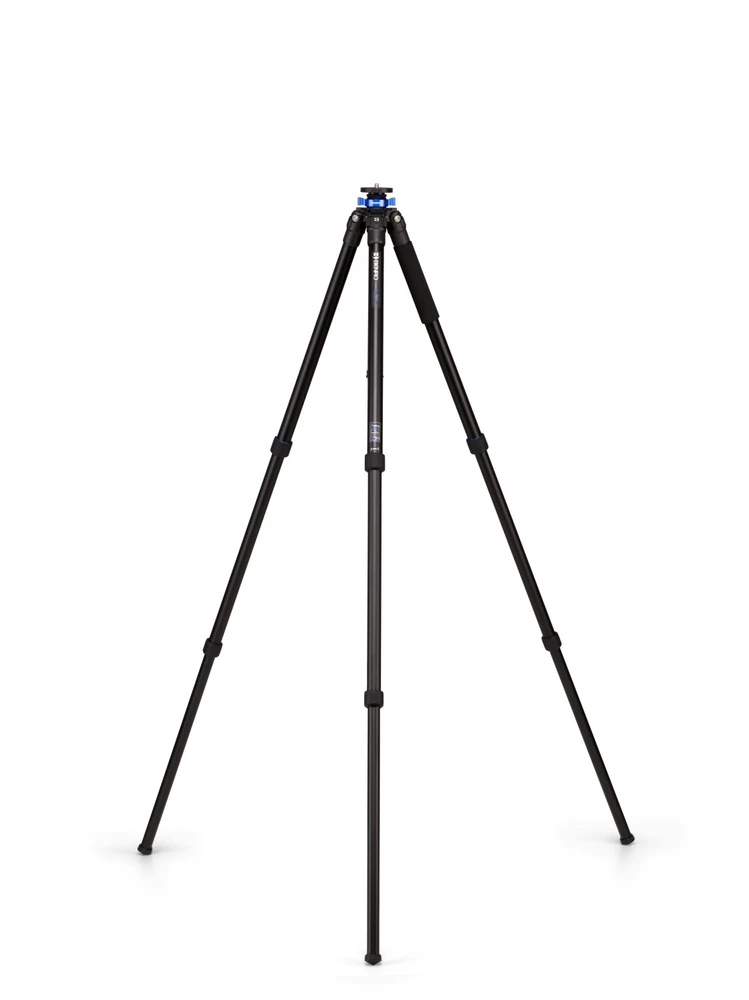
Explore this need in the finder →The Benro TMA37AL is a long, three-section aluminum tripod sold without a camera head. Its headline reach, 68 cm closed length and 2.36 kg manufacturer-listed product weight answer different questions: maximum support height, storage envelope and the bare tripod's published mass. This is an assessment of the exact U.S. SKU from product documentation, not a hands-on test or ownership report.
Identify the legs-only TMA37AL
Benro's U.S. page identifies the Mach3 AL Series 3 Long Tripod as SKU TMA37AL. It lists aluminum legs, three sections, rubber twist locks and a 3/8-inch-16 head mount. The maker's item-includes list names the tripod and carry case but no head; B&H's exact-MFR listing also describes a head chosen separately. The common mounting thread is a useful interface starting point, not proof that every head, clamp, plate, camera or cage fits. Check the whole attachment stack before buying a separate head.
Do not confuse TMA37AL with the visually similar Mach3 TMA37C carbon-fiber model, or with the taller TMA47AXL. The reviewed TMA37AL is specifically aluminum and Series 3 Long; its source-listed three leg sections are not four. B&H's exact TMA37AL item list names three metal spikes, three rubber feet, a short center column and carry case. Benro separately advertises spikes and the short column, but its own item-includes list is shorter. Verify those small components in the seller's actual package rather than treating one retailer's list as a guarantee for every offer.
Read the height as a configuration, not eye level
Benro lists 179 cm maximum with the center column extended and a 41 cm minimum. B&H's exact-MFR specification rounds maximum height to 179.1 cm and separately lists 149.6 cm with the center column down; that lower column-down figure is retailer evidence, not a field in Benro's inspected specification table. For the finder, the manufacturer's precise 179 cm value is the upper-height field: a 179 cm minimum listed maximum admits it, whereas 180 cm does not. This is not camera or viewfinder height. A separately selected head, plate, body and your stance all alter the final viewing position.
Benro says the short column is included for ground-level shooting, and B&H explains that it replaces the longer column. That provides another way to configure the support; it does not establish clearance for a particular camera, long lens or cage near the floor. Nor does the ordinary removable/short-column arrangement prove that the column can swing horizontally. The exact product page and retailer listing checked here do not document that capability or explicitly establish its absence, so its horizontal status remains unknown.
Longer in the bag, heavier than a compact travel option
Benro lists a 68 cm closed length; B&H's exact-model figure rounds to 68.1 cm. That is the tripod's folded specification, not the internal length, zipper opening or padded clearance of its case. A 68 cm whole-centimeter carrying limit includes the maker's field, while a 67 cm limit excludes it. Measure the intended storage space rather than assuming the supplied case will fit a particular compartment, and check whether the separately selected head can remain attached during transport.
The manufacturer's 2.36 kg product-weight figure is not a complete carry-system weight. B&H rounds its listing to 2.4 kg; neither source says that the tripod figure includes every small part, case, separate head, camera or lens. In the questionnaire's 0.1 kg increments, a 2.4 kg cap is above Benro's listed 2.36 kg, while 2.3 kg is below it. A traveler with a strict total mass ceiling should add the actual head and camera kit and treat the case as another item to account for, rather than using the tripod number as a packed-system measurement.
Construction claims and listed load have limits
Benro describes magnesium castings where used, rubber twist locks, a three-section aluminum set and tube diameters of 32.4, 28.6 and 25.2 mm. The product page calls the locks high-performance and resistant to the elements; those are manufacturer descriptions, not measurements of sealing, grip, corrosion life, lock speed, stiffness or long-term wear. No assembly, leg adjustment or weather exposure was performed for this review.
Benro publishes a 16 kg maximum payload. That is a manufacturer rating, not an independently tested safe load or proof that an extended or off-center camera arrangement will be steady. The included spikes and rubber feet indicate different contact pieces, but do not establish which is suitable for a particular floor, soil, rock, ice, slope or venue. Follow the exact unit's instructions and check the actual surface and permitted foot type; do not infer stability from a payload number.
What the sources do not settle
The Benro USA manuals index reviewed for this assessment does not name TMA37AL or map a Mach3 document to this exact code. That is an index limitation, not proof that no instructions exist. I have not borrowed a procedure from a neighboring Mach3 or older tripod family. Ask for documentation that specifically applies to the purchased unit before relying on an adjustment or service instruction. Benro's product page also displayed both a future expected date and an out-of-stock notice when checked, so this review makes no claim about present availability or any particular seller offer.
The TMA37AL is worth comparing when you want a headless, aluminum, twist-lock support with a listed 179 cm maximum, and can accommodate a roughly 68 cm fold plus a maker-listed 2.36 kg before the rest of the camera system. It is less compelling if a short packed length, very low carried mass, a supplied head, or verified horizontal-column movement is essential. Before choosing an offer, confirm the exact TMA37AL code, package parts, case and storage fit, separate head and plate compatibility, and applicable instructions. The specifications make a shortlist possible; they do not replace a complete-system check or real stability testing.
Use the exact model’s instructions for operating limits, supplied equipment and version differences.Key specifications
Key details at a glance
Listed support or kit weight 2.36 kg Leg material Aluminum Maximum height (as listed) 179 cm Maximum height, column down 149.6 cm Minimum height 41 cm Closed length 68 cm Leg sections 3 Leg-lock style Twist locks Head supplied with tripod legs No Upper head attachment 3/8"-16 male
Make the choice fit your whole camera setup
Start with your head, camera and lens, then use the published figures as screening limits rather than field-performance claims.