
Your needs, this model
Does it fit your priorities?
Is the head in TSL08AS2CSH a fluid video head, and what comes in the kit?
Benro's exact page lists the S2CSH pan-and-tilt video head with smooth damping, camera plate and carrying case; B&H's exact-MFR page classifies this head as fluid. The listing does not prove a particular movement feel or fit with every cage. Check the full TSL08AS2CSH code, plate clamp and pan bar in the actual offer.
Explore this need in the finder →Does its center column swing sideways, and what height should I plan around?
The grooved center column is described as reversible for low shots, not horizontally positionable. Benro lists 145 cm maximum with the column raised and a separate 121.5 cm maximum working-height field. Neither dimension is the camera's viewfinder position, so compare your camera/head stack and operating posture before deciding the reach is enough.
Explore this need in the finder →Can the TSL08AS2CSH meet a compact, light carry limit?
The exact maker table lists 52 cm closed and 1.48 kg product weight; it reaches 145 cm overall with the center column extended. It meets a 52 cm fold ceiling, 1.5 kg tripod-weight ceiling and 145 cm listed-height minimum, but fails a 51 cm, 1.4 kg or 146 cm limit. Add camera, lens and bag weight separately.
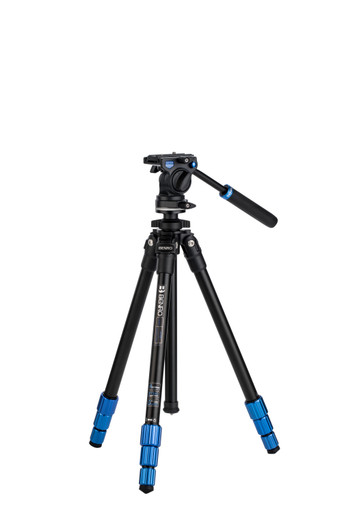
Explore this need in the finder →The TSL08AS2CSH is the aluminum Slim video kit with an included S2CSH pan-and-tilt head. Benro lists four leg sections, half-turn twist locks, a vertical reversible center column, 145 cm maximum height, 121.5 cm maximum working height, 52 cm closed length and 1.48 kg product weight. A soft case is listed with the kit. The separate 2.5 kg payload field is a manufacturer rating, not an independent camera-rig test.
Small carry load, deliberately modest payload
The attractive published figures are a 52 cm fold and a 1.48 kg product weight. They make this a comparatively light support among video kits, but they do not establish the usable opening of the included case or the total weight after adding a camera, lens, plate accessories and personal carry items. Measure the bag you plan to use. Benro's page lists fixed rubber feet; it does not show a field-tested traction result on a wet floor, smooth stage or outdoor surface.
Benro describes the tripod as suitable for mirrorless or compact DSLR video work and lists a 2.5 kg maximum payload. Treat that as a published system limit, not permission to load any rig up to that mass in any position. A long lens, cage, monitor, microphone or offset arm changes leverage. Check the actual camera and lens weight together with the plate, balance point and required tilt range. The rating does not predict head drag, vibration or motion quality.
Read the two height figures correctly
The specification table lists 145 cm as maximum height and 121.5 cm as maximum working height. B&H describes the overall maximum as 57 inches with the center column raised. Both numbers are real listing fields, but they answer different setup questions. If you need 145 cm of support reach, the column must be used at its upper position; if you need a lower-column working setup, the separately listed 121.5 cm matters. Neither is the height of your viewfinder or sensor after fitting a head, plate and camera.
The center column is grooved and reversible for low-to-the-ground work. Reversal is not the same as horizontal positioning: this model does not document a sideways swing arm. The column also has a hook beneath it, which Benro describes for hanging ballast in windy conditions. No test or blanket stability guarantee follows from that accessory. Confirm that the camera can reach your intended low angle without the head, plate, lens or column interfering.
What the S2CSH head adds—and what remains a fit check
Benro identifies the supplied head as S2CSH, calls it a pan-and-tilt video head and describes smooth damping on both axes. B&H's exact-MFR listing classifies the head as fluid and identifies the kit as a tripod, video head and soft case. That is enough to treat it as a fluid-video-head package in the comparison; it is not a claim that the panning feel was tested. Benro also identifies an Arca-Swiss-compatible quick-release plate and a 1/4-20 camera screw. Check the actual plate profile, screw length and camera/cage clearance rather than assuming every Arca-type clamp is identical.
The four sections use twist locks that Benro says need only a half turn. That is the manufacturer's description, not a measured setup-time or durability result. The legs can be positioned individually for uneven surfaces, and the head and tripod each have bubble levels according to the product text. A bubble level helps show orientation; it does not certify the floor, center of gravity or safety of an extended load.
Who should shortlist it?
Consider the TSL08AS2CSH for a light video kit when 1.48 kg product weight, a 52 cm fold, four twist-lock sections and the supplied S2CSH head match the camera and carry plan. It is less suitable if the rig is near or above the 2.5 kg published limit, if a 121.5 cm column-down maximum is too short, or if a horizontal center-column position is essential. Confirm the full model suffix, included head, plate, case and current package with the seller. The consulted Benro U.S. manuals index did not display an exact TSL08AS2CSH entry; it is an index limitation only. No setup, damping, load or stability test was conducted for this review.
Key specifications
Key details at a glance
| Listed support or kit weight | 1.48 kg |
|---|---|
| Leg material | Aluminum |
| Maximum height (as listed) | 145 cm |
| Minimum height | 41 cm |
| Closed length | 52 cm |
| Leg sections | 4 |
| Leg-lock style | Twist locks |
| Head supplied with tripod legs | Yes |
| Head type | Fluid video head |
| Carrying bag included | Yes |
| Manufacturer maximum working height (separate maker field) | 121.5 cm |
Use the exact model’s instructions for operating limits, supplied equipment and version differences.
Sources for this review
Sources for this assessment

Make the choice fit your whole camera setup
Start with your head, camera and lens, then use the published figures as screening limits rather than field-performance claims.