
Your needs, this model
Does it fit your priorities?
Does the TTOR24CFS36PRO reach a 133 cm minimum listed maximum-height requirement?
No. Benro lists a 132.8 cm maximum for the exact kit, so it passes a height-only 132 cm minimum but falls out at 133 cm. That published tripod maximum is not your camera's final viewfinder height.
Explore this need in the finder →Which head package and plate route does this Tortoise kit document?
Benro lists the FS36PRO video head in the exact TTOR24CFS36PRO kit, with 501 and Arca-type quick-release compatibility. Check the seller's precise plate and its retention details before mounting your camera or cage.
Explore this need in the finder →Does the published closed size fit a 57 cm storage ceiling?
Not under the exact manufacturer figure: the kit is listed at 57.2 cm closed, so a 57 cm ceiling excludes it and a 58 cm limit admits it. Allow additional clearance for a bag or attached gear, whose exact dimensions are not established here.
Explore this need in the finder →Assessment basis: This is a source-based review of the exact US Benro TTOR24CFS36PRO, not a hands-on test. I compared Benro USA's model page and the matching FS36PRO head information with an exact-MFR US retailer listing. Published payloads and feature descriptions do not establish camera-specific balance, motion smoothness, stability, vibration behavior or durability.
A Tortoise tripod sold with a video head
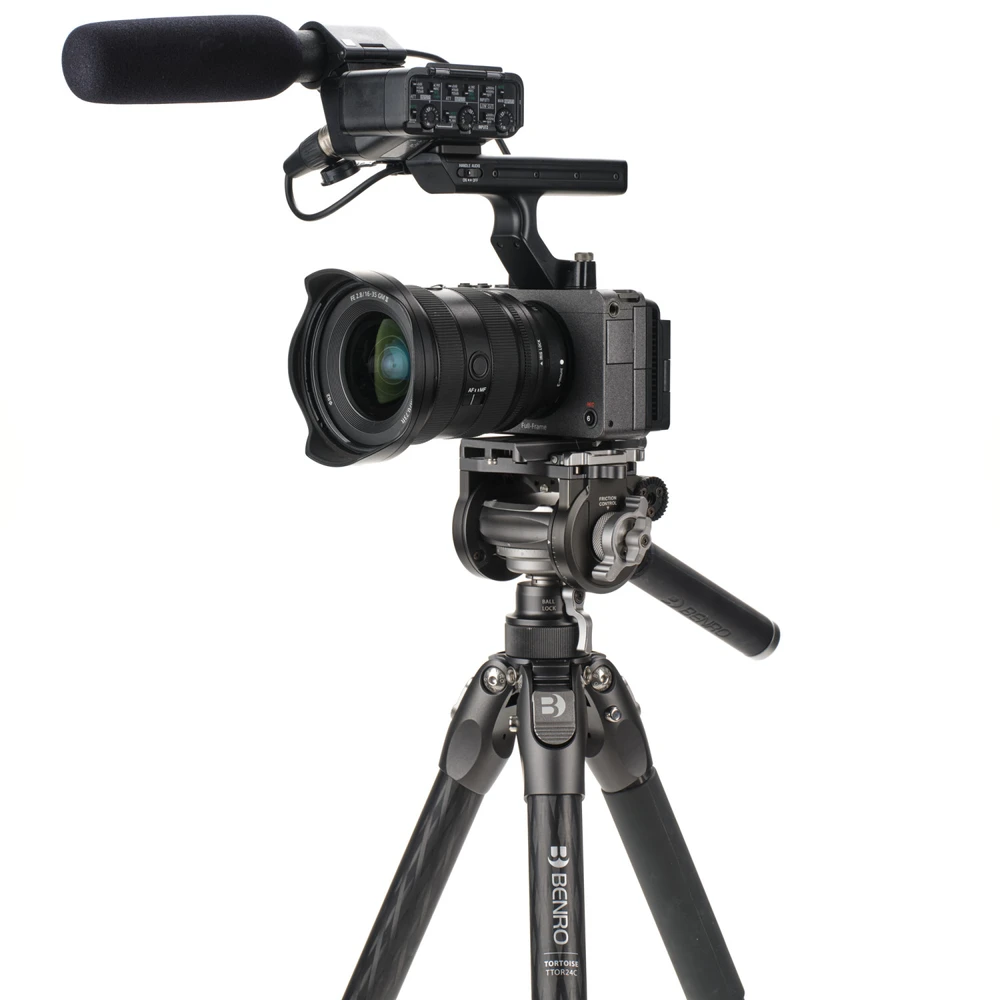
The TTOR24CFS36PRO is a four-section carbon-fiber Tortoise kit, not a bare set of legs and not the taller KingPod package with a similar FS36PRO head. Its included head is a key part of the decision: Benro calls it a video head and lists pan, tilt, drag, a 36 mm ball, and a 45 mm flat base with a 3/8-inch mount. B&H's exact-code US listing describes the inverted-ball head as fluid. That combination places the kit in the video-head category for this library, but it does not tell you how a fully rigged camera will balance or move.
The FS36PRO is deliberately a hybrid interface. Benro identifies 501-style and Arca-type quick-release compatibility, so a user who alternates a video rig and a stills body may avoid carrying two unrelated heads. Compatibility is not the same as certainty about a particular cage or plate: check the exact plate supplied, screw type, clamp direction and retention method. The kit specification marks a quick-plate safety mechanism while also using an unclear “without security mechanism” label for the plate lock. I would verify the precise catch and plate with the seller or manufacturer before mounting an expensive rig.
Published height, carry size and low placement
Benro lists a maximum height of 132.8 cm, a minimum of 22.3 cm, a closed length of 57.2 cm and a complete kit mass of 2.1 kg. Those figures describe a fairly compact support package, not a pocket-sized tabletop tripod: folded, it is still longer than many small bags are deep, and the FS36PRO is already part of the 2.1 kg figure. The 6 kg payload is a maker rating, not a tested safe working load for every off-center lens, monitor or cage.
The height is the main constraint. A buyer who needs a published maximum of at least 133 cm should not treat the displayed 132.8 cm as a pass simply because it rounds to 133. The whole-centimeter finder accepts 132 cm and removes the kit at 133 cm. Either way, maximum tripod height is not viewfinder height; body, plate, head position and eye level all affect the framing you actually get. Compare those measurements against your own setup rather than assuming that a carbon-fiber kit's payload rating guarantees a steady extended frame.
On the other hand, the 22.3 cm listed minimum and Benro's notes about independent leg spread and near-flat leg positioning make low camera placement a documented use case. That is a useful distinction from merely lowering a center column. But the manufacturer does not specify a horizontal-column position for this SKU. I have left that capability unknown rather than assigning a sibling Tortoise's layout or inferring a mechanism from the family name. If your macro work requires the camera to reach sideways over the legs, check before buying.
What the included head does—and what remains uncertain
The head's inverted 36 mm ball is intended to level the head without repositioning the tripod legs, while the separate pan arm supports a video-style control workflow. Benro's exact kit table lists fixed pan and tilt drag; the separate FS36PRO component page uses different wording for tilt drag and describes operator-side friction controls. The sources agree on the head's broad role and plate compatibility, but not on a detailed drag range. If variable drag is essential, ask about the exact current head revision and test it before relying on the listing. No claim about fluid motion quality is made here.
The exact kit page also documents twist locks, four leg sections, independent leg spread, a weight hook, and rubber and spiked feet. Four sections mean more locking stages than a three-section tripod; that is a practical setup consideration, not a measured speed or durability finding. The manufacturer does not clearly establish bag inclusion or every loose accessory in the package. Confirm those details and follow the exact instructions for the feet, head locks and camera plate.
Where it sits beside the KingPod
The closest useful comparison is Benro's TKPD24CFS36PRO KingPod, which uses the same FS36PRO hybrid head but is a different tripod SKU. Benro lists the KingPod at 175 cm maximum, 65.5 cm closed and 2.55 kg; its source record describes additional mini-tripod and monopod modes. The Tortoise is 42.2 cm shorter at its listed maximum, 8.3 cm shorter folded and 0.45 kg lighter by the two manufacturer records. It gives up the documented conversion modes and extra height in exchange for the smaller published envelope. These are specification comparisons, not comparative stability results.
A photographer who wants a higher eye-level platform or expects to use the KingPod's alternate support modes should compare the KingPod review instead. A hybrid shooter who wants the included FS36PRO, prefers the lower listed kit mass, and can work within the Tortoise's 132.8 cm maximum has a more focused configuration here. Buyers seeking a conventional ball head for still photography should also compare the VX30-equipped FRHN34CVX30 rather than choosing this kit because “Arca” appears in the description; the head's movement and control layout are materially different.
Bottom line: The TTOR24CFS36PRO's documented case is an included FS36PRO video head on low-angle-capable four-section carbon legs, with 501/Arca compatibility and a shorter, lighter published envelope than the similar KingPod. Its short maximum height, fixed-drag wording, ambiguous plate-safety label and unconfirmed bag contents are real checks, not details to assume away. Read the head and plate guide, then compare the exact same-condition finder result for a broader shortlist.
Key specifications
Key details at a glance
| Listed support or kit weight | 2.1 kg |
|---|---|
| Leg material | Carbon fiber |
| Maximum height (as listed) | 132.8 cm |
| Minimum height | 22.3 cm |
| Closed length | 57.2 cm |
| Leg sections | 4 |
| Leg-lock style | Twist locks |
| Head supplied with tripod legs | Yes |
| Head type | Fluid video head |
| Upper head attachment | 36 mm inverted leveling ball; 45 mm flat base; 3/8-inch thread |
Use the exact model’s instructions for operating limits, supplied equipment and version differences.
Sources for this review
Sources for this assessment
- Benro USA Photo Tripods catalogue, page 1, exact TTOR24CFS36PRO card
- Benro Tortoise CF 2 Series, 4 Section Tripod with FS36PRO Hybrid Head — TTOR24CFS36PRO
- Benro Tortoise 4-Section Tripod with FS36PRO Head — exact MFR TTOR24CFS36PRO
- Benro FS36PRO Head exact component page
- Benro USA exact Tortoise CF 2 / FS36PRO product-gallery image

Make the choice fit your whole camera setup
Start with your head, camera and lens, then use the published figures as screening limits rather than field-performance claims.