
Your needs, this model
Does it fit your priorities?
Does the GM4552L work as a three-legged camera tripod?
No. Gitzo identifies the GM4552L as a Series 4 Long monopod: one leg, not a three-leg tripod or complete tripod kit. The finder’s “legs only” choice means tripod legs without a head; it does not classify this monopod as a finder match.
Explore this need in the finder →What head connection and package should I verify for the GM4552L?
Gitzo lists a reversible 1/4-inch and 3/8-inch top screw for the GM4552L. The exact model page does not establish a separately supplied head or a particular third-party seller box; confirm the full model code, thread orientation, head and included parts before ordering. The finder’s ball-head choice is for a complete tripod kit, not this monopod.
Explore this need in the finder →How should I compare the GM4552L height and packed size with a tripod?
Gitzo lists 190 cm maximum height and 56 cm closed length for this exact monopod. Maximum support height is not your camera’s viewfinder height, and this reference is not included in the tripod finder. The linked finder scenario uses a 190 cm minimum height and 56 cm folded limit to compare whole-tripod options, not to certify the GM4552L as a match.
Explore this need in the finder →Gitzo’s U.S. page identifies the GM4552L as its Series 4 Long, five-section monopod. The technical table lists 190 cm maximum height, 56 cm closed length and a 0.73 kg mass. It also gives a 35 kg Safety Payload under UNI/PdR 105:2021. Those are manufacturer fields, not independent measurements or a finding that a 35 kg camera-and-head combination will be stable. This article assesses the exact monopod model as a reference; it is not a three-legged tripod match or a hands-on test.
The long model is about reach, not a tripod stance
At 190 cm, GM4552L has the tallest maximum-height figure in this six-card Gitzo monopod group. The manufacturer specifically presents it for shooting over crowds and fences, where raising a camera above an obstacle with a narrow support point may be useful. That is a maker-described use, not a claim that the monopod will clear every barrier or hold every camera steadily at full extension. A 190 cm support height is not the viewfinder height of a camera mounted on top, nor does it say how high a person can compose comfortably. The camera’s position, any separately chosen head, the lens and the operator’s stance all change the working arrangement. The one-legged format also differs fundamentally from a tripod: it does not provide a three-point base that can be left standing on its own. Anyone who needs that kind of support should start with the complete-tripod finder.Five sections and the carrying compromise
The GM4552L is listed at 56 cm closed and 0.73 kg. Compared with the three-section GM4532, it reaches 27 cm higher and closes 10 cm shorter, but weighs 0.06 kg more and uses two additional sections. Compared with the compact six-section GM4562, the GM4552L reaches 36 cm higher, is 12 cm longer when closed and weighs 0.06 kg more. These are exact page figures for different configurations, not a ranking of rigidity or handling. For travel, 56 cm is still a substantial closed length. “Long” in the model name is consistent with the manufacturer’s use of the product as a taller model, not evidence that it is easy to stow in every pack. Measure the intended compartment and account for the camera, lens, head and any replacement foot or spike. The published monopod mass is not a full-system carry weight.CarbonExact tubes and mounting details
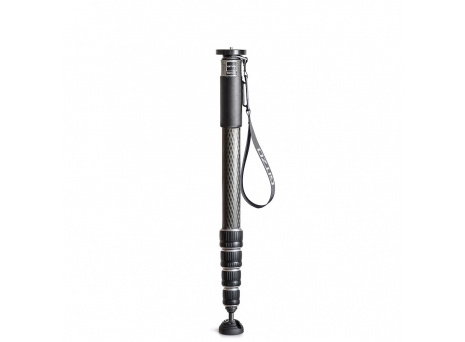
Gitzo lists CarbonExact material, G-Lock Ultra twist locks, five leg sections and tube diameters from 21.7 to 37 mm. The page describes a reversible 1/4-inch and 3/8-inch top screw for mounting a camera, lens or head. That is an interface to verify against your actual equipment; it does not establish a head is supplied. The exact U.S. table says no carrying bag, and it also lists no Easy Link accessory connection and no fluid base. The model page describes a 50 mm rubber foot with a pivoting ball joint and a removable wrist strap. It says the foot can be removed and replaced with optional feet or metal spikes. These descriptions establish the parts Gitzo lists, not how the foot will grip a particular surface or how the support will behave with a given rig. The 35 kg safety-payload value is a standardized manufacturer field, not a tested payload limit for your combined camera, head and lens.Why this model stays a reference
The exact product identity is a carbon-fiber monopod, not a complete tripod. Its reach, fold and interface can help someone distinguish a GM4552L listing from another Gitzo code, but they do not make it appropriate for a request that requires three legs or an included tripod head. This site retains the exact model guide and a separate model lookup so readers can identify it, while excluding it from ordinary tripod recommendation matches.Before choosing an offer
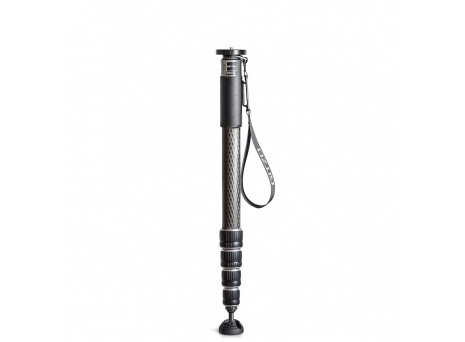
Check for the complete code GM4552L, five sections, 190 cm maximum and 56 cm closed length. Confirm whether an offer includes anything beyond the monopod; the manufacturer page does not verify a third-party seller’s box, current stock, price or condition. Check the reversible top thread, foot type, strap and any head or adapter needed for your setup. The official photograph is associated with the GM4552L U.S. model card and shows the single-leg support, not a complete camera package. No independent field test or stability comparison is implied by the published specifications.Key specifications
Key details at a glance
| Listed support or kit weight | 0.73 kg |
|---|---|
| Leg material | Carbon fiber |
| Maximum height (as listed) | 190 cm |
| Minimum height | 56 cm |
| Closed length | 56 cm |
| Leg sections | 5 |
| Leg-lock style | Twist locks |
| Upper head attachment | Reversible 1/4-inch and 3/8-inch screw |
| Carrying bag included | No |
| Easy Link accessory connector | No |
| Manufacturer safety-payload figure (UNI/PdR 105:2021) | 35 kg |
Use the exact model’s instructions for operating limits, supplied equipment and version differences.
Sources for this review
Sources for this assessment
Make the choice fit your whole camera setup
Start with your head, camera and lens, then use the published figures as screening limits rather than field-performance claims.