
Your needs, this model
Does it fit your priorities?
Does the GT1545TUS include a ball head?
No. GT1545TUS is the tripod-legs model, not the GK1545T-82TQDUS ball-head kit. Its reversible top fixing screw accepts a separately chosen compatible head.
Explore this need in the finder →Can GT1545TUS reach a 153 cm minimum support-height requirement?
Gitzo lists 153 cm maximum height and 130 cm with the center column down. It meets a 153 cm tripod-height floor only at its listed maximum; that is not camera-eye height or a steadiness guarantee.
Explore this need in the finder →How does its fold compare with the five-section GT1555TUS?
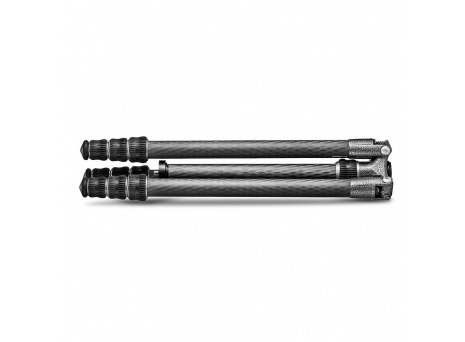
The four-section GT1545TUS folds to 42.5 cm and reaches 153 cm; the five-section GT1555TUS folds to 35.5 cm and reaches 138 cm. Both are headless, so compare the same separately selected head and camera setup.
Explore this need in the finder →This source-led assessment is for the Gitzo Traveler GT1545TUS, the headless four-section Series 1 version. It is not a hands-on test. Its useful distinction from the five-section GT1555TUS is not that one is universally better: the GT1545TUS reaches 153 cm, while the GT1555TUS folds shorter at 35.5 cm and tops out at 138 cm.
More reach than the five-section Series 1
Gitzo lists 153 cm maximum height, 22 cm minimum height and 42.5 cm folded length for GT1545TUS. Its 1.055 kg weight is only the tripod configuration, not a complete camera support, because a head is not included. Gitzo's product page also gives 130 cm as the maximum with the center column down. That figure can help a shopper compare a lower-column configuration with full extension, but it does not measure flex or prove that a camera will remain still at any particular focal length.
For a direct comparison, GT1555TUS is a five-section model at 1.03 kg, 138 cm maximum and 35.5 cm folded. The GT1545TUS saves a section and gains height, but packs 7 cm longer. Both pages show carbon-fiber legs and the same general headless use. If the head you own is already part of your kit, use its exact footprint and attachment when calculating bag space; the legs' closed length alone does not describe the full camera system.
A removable center column is not a horizontal arm
The GT1545TUS has a rapid center column and Gitzo says a short column is included for lower camera placement. The official Traveler instructions describe raising and lowering the column, adjusting the legs to a lower angle and using the short column for ground-level work. They do not describe a 90-degree pivot. If horizontal positioning is essential for a copy stand or side-reaching macro task, this model should not be treated as satisfying that requirement.
The product page lists two leg-angle positions, 25 and 70 degrees, and twist-lock sections. A low-angle setup depends on positioning the legs and short column as the manufacturer instructs; it is not a continuous range of arbitrary spread settings. Gitzo describes the tubes as Carbon eXact carbon fiber and the Traveler locks as compact twist collars. Those construction and mechanism descriptions help identify the configuration, but they do not establish the tripod's feel, wear rate or stability through field use.
Headless attachment and published load rating
GT1545TUS uses a reversible 1/4- or 3/8-inch fixing screw at the top. Select a head with the matching thread and verify any plate or clamp you intend to use. A headless set is flexible if a photographer already owns a suitable head, yet it requires one more compatibility decision and the head's extra mass needs to be included in a real carry estimate. The exact Gitzo page lists no carrying bag, although it does list a shoulder strap.
The manufacturer rates this model at 10 kg under UNI/PdR 105:2021. That is a standardized Safety Payload Weight, not a test of a long lens, side-mounted camera, wind gust or soft ground. Gitzo's product description recommends lenses around 135 mm with 200 mm as a stated maximum. That is the manufacturer's guidance, not an assurance that every lens at that focal length will frame sharply on every surface. Match the head, load distribution, column extension and environment to your actual setup.
Who should consider GT1545TUS
This model is worth comparing when a headless, four-section support that reaches 153 cm matters more than the 35.5 cm fold of GT1555TUS. It is a weaker fit when a ready-supplied ball head, a shorter packed length or a horizontal-column mechanism is essential. Before choosing, verify GT1545TUS rather than the related GK1545T-82TQDUS kit, check your head's thread, and compare the 42.5 cm folded dimension with the space available in your bag. No claims about stability or practical comfort here come from direct use.
Key specifications
Key details at a glance
| Listed support or kit weight | 1.05 kg |
|---|---|
| Leg material | Carbon fiber |
| Maximum height (as listed) | 153 cm |
| Minimum height | 22 cm |
| Closed length | 42.5 cm |
| Leg sections | 4 |
| Leg-lock style | Twist locks |
| Head supplied with tripod legs | No |
| Upper head attachment | Reversible 1/4- or 3/8-inch fixing screw |
| Carrying bag included | No |
| Manufacturer safety-payload figure (UNI/PdR 105:2021) | 10 kg |
| Leg-angle positions | 25 / 70° |
Use the exact model’s instructions for operating limits, supplied equipment and version differences.
Sources for this review
Sources for this assessment
Make the choice fit your whole camera setup
Start with your head, camera and lens, then use the published figures as screening limits rather than field-performance claims.