
Your needs, this model
Does it fit your priorities?
Can I mount a head I already own on the 117B?
The exact 117B product page lists a 3/8-inch top screw, and the exact-code US listing describes heads as optional rather than included. This is a legs-only arrangement: confirm the head's base thread, safety instructions, plate and camera clearance before assembling it. The matching record does not verify a particular head or payload combination.
Explore this need in the finder →Will the 117B reach my published tripod-height minimum and fit in storage?
The product page and exact-code US listing agree on a 173 cm maximum, 147 cm with the column down, a 46 cm minimum and a 94 cm closed length. Those tripod figures do not predict your viewfinder position, and the long closed measurement should be checked against the actual vehicle, case or room opening.
Explore this need in the finder →Can I set a strict 117B carry-weight ceiling from the published sources?
Not from the evidence reviewed: the exact-model manufacturer page lists 6.3 kg while the exact-code US retailer lists 5.7 kg. The matcher intentionally leaves weight unknown, so the 117B will not pass a maximum-weight requirement even when the entered limit exceeds either figure. Ask for the exact seller configuration and a reliable specification before using it for a hard carry limit; add the head and camera either way.
Explore this need in the finder →The Manfrotto 117B is a tall twin-leg video tripod for a separately chosen head, not a ready-to-shoot still-camera kit. Its useful distinction is a geared center column within a braced, two-section support; the corresponding compromises are a 94 cm closed length, substantial mass, and a manufacturer-versus-retailer weight conflict. This is a source-based assessment of the exact 117B configuration, not a hands-on test.
What the 117B configuration includes
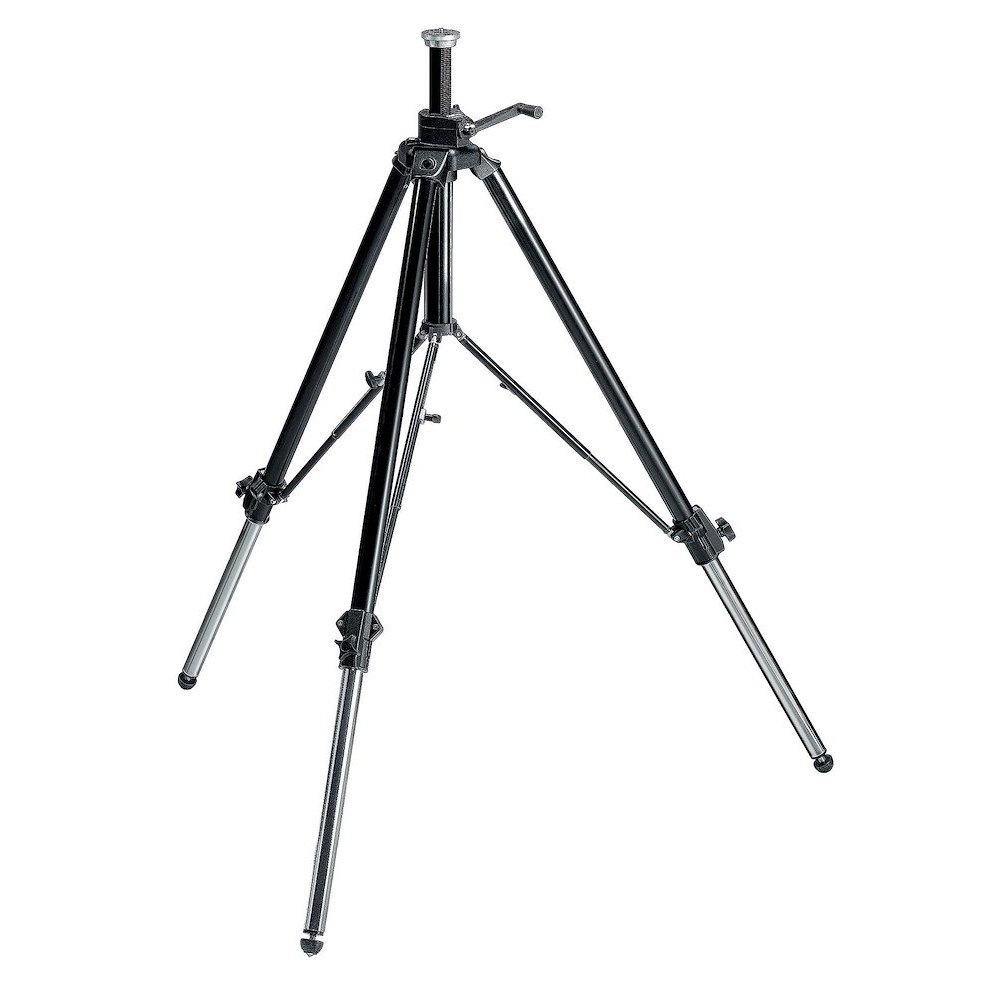
The exact manufacturer product page identifies the 117B and lists twin legs, two sections, a geared center column, a telescopic mid-level spreader, rubber feet with retractable metal spikes and a 3/8-inch top screw. The exact-code US retailer listing identifies heads as optional and names the tripod as the included item. Treat this as legs-only: no particular pan, ball or fluid head, quick-release plate, camera, dolly or carrying case is established as part of the package.
The manufacturer describes aluminum-and-steel construction, with stainless-steel tubes at the base; a related 117-series instruction sheet describes anodized aluminum legs with steel extensions. “Aluminum” is therefore a useful primary-material classification for the legs, not a claim that every structural element is aluminum. The locking system is described as turn-lock. It is not the flip-lock or twist-lock type represented by the finder’s two lock-style choices.
A geared column and braced footprint
The column is geared for vertical adjustment. That can be useful when a controlled height change matters, but it is a different operation from the 90-degree column systems documented on some photo tripods in the 055 family. The 117B's product specifications and its exact product image show a fixed geared column; the manufacturer’s related 117-series manual explains raising and lowering that column, with a separate lower 3/8-inch attachment for low-level work when fully lowered. Because that manual identifies 117/117X and USA 3068 variants rather than 117B by name, confirm instructions for the exact item before relying on the secondary attachment detail.
The telescopic mid-level spreader braces the legs and allows different spread positions according to the product documentation. Its rubber feet and retractable spikes give two contact configurations, but they do not remove the need to check the floor, ground, slope and site rules. Retract spikes before using a surface that could be scratched; on loose ground, verify the feet and spreader are set exactly as the instructions require. Neither a wide stance nor a spike is proof of stability under wind or an off-center video rig.
Read the dimensions as a system, not a promise
The manufacturer lists a 46 cm minimum, 173 cm maximum and 147 cm maximum with the center column down; the exact-code US listing agrees on those heights. The difference between column-up and column-down numbers is worth considering if you expect to avoid column extension. A tripod maximum still does not equal the camera’s viewfinder height: the chosen head and plate add height, while camera placement and monitor position affect the actual composition.
At 94 cm closed, the 117B is a long object to store and transport. The manufacturer’s product page lists no carrying bag. A separate 117-series manual describes a transport strap as optional for the US version, but it is not an exact 117B package confirmation. Measure your storage space and ask the seller what the exact listing includes rather than assuming that a product-family accessory ships with this configuration.
Weight deserves a special warning. The current exact-model manufacturer specification states 6.3 kg, while the exact-code US retailer lists 5.7 kg. The family instruction manual also has a 5.7 kg figure, but it does not establish a 117B-specific weight and does not resolve the disagreement. The finder therefore leaves the 117B’s mass unknown: it will not pass a hard maximum-weight request merely because a limit is set above either published number. Confirm the exact model and weigh or verify the actual seller’s configuration before planning a carry. Add the selected head, camera, lens and any bag in either case.
Payload wording needs context
The manufacturer names an 18 kg Safety Payload Weight. That is a standardized manufacturer rating, not an independent test of this tripod with your head, camera, lens, column extension or leg spread. The retailer page separately displays a converted capacity figure but its detailed specifications say a manufacturer load capacity is not specified. This discrepancy is another reason not to turn a headline number into a promise that a particular rig will remain steady or safe. Follow the manual and head instructions, and evaluate the whole mounting system rather than comparing payload numbers in isolation.
Compare it with the support you actually need
Compared with a photo-oriented Manfrotto 055 such as the MT055XPRO3, the 117B is far longer folded and heavier by the published figures, but it offers twin legs and a geared, braced video-support layout. The 055 instead has a documented horizontal-column mechanism and is sold as standalone photo legs in this comparison. A studio-oriented 475B is also a separate-head geared tripod, but it is a different single-column design with documented flip locks and an 80 cm closed length. Those are source comparisons, not measured rankings in vibration, setup speed or field steadiness.
The 117B makes most sense as a candidate for a user who has a reason to want a tall, spreader-braced video tripod and is prepared to choose a compatible 3/8-inch head. It is less convincing if a compact travel package, a known carried weight, an included head, or a documented sideways column is essential. Confirm the exact 117B code, its head and plate, the seller’s package, the disputed mass and any return terms before proceeding. The manufacturer’s 117B product page, related 117-series instruction sheet and exact-code US listing identify the evidence used; seller availability, price and customer opinions are not part of this assessment.
Key specifications
Key details at a glance
| Leg material | Aluminum |
|---|---|
| Maximum height (as listed) | 173 cm |
| Maximum height, column down | 147 cm |
| Minimum height | 46 cm |
| Closed length | 94 cm |
| Leg sections | 2 |
| Leg-lock style | Turn-lock mechanism |
| Head supplied with tripod legs | No |
| Upper head attachment | 3/8-inch screw attachment |
| Carrying bag included | No |
| Manufacturer safety-payload figure (UNI/PdR 105:2021) | 18 kg |
Use the exact model’s instructions for operating limits, supplied equipment and version differences.
Sources for this review
Sources for this assessment
Make the choice fit your whole camera setup
Start with your head, camera and lens, then use the published figures as screening limits rather than field-performance claims.