
Your needs, this model
Does it fit your priorities?
Does MH01HY-3WUS include tripod legs?
No. MH01HY-3WUS is the standalone Befree three-way head, not a complete tripod or legs-only support. This finder link keeps the legs-only condition for whole-tripod products.
Explore this need in the finder →Would MH01HY-3WUS satisfy a ball-head tripod-kit requirement?
No. Manfrotto documents this as a three-way hybrid head, not a ball head, and it is sold as a separate head rather than a complete tripod kit. This link preserves the ball-head-included condition for whole supports.
Explore this need in the finder →Does MH01HY-3WUS come as a complete three-way-head tripod kit?
No. MH01HY-3WUS is itself a three-way head with foldable controls, but it is not a tripod kit with legs. This finder link preserves the three-way-head-included requirement for whole tripods and does not imply that a kit contains this exact head.
Explore this need in the finder →Would MH01HY-3WUS satisfy a fluid-video-head tripod-kit requirement?
The MH01HY-3WUS has maker-described fluid cartridges on pan and tilt, but it is a standalone head without tripod legs. This link keeps the fluid-video-head requirement for complete tripod kits; it is not a compatibility or exact-kit claim.
Explore this need in the finder →The Manfrotto Befree 3-Way Live Head (MH01HY-3WUS) sits between a compact still-photo three-way head and a small hybrid photo/video head. The manufacturer describes three independent axes and fluid cartridges on pan and tilt, with controls that fold down for storage. It is still a standalone head: the model does not supply the tripod legs needed to make a complete support. That boundary is more important than the travel-oriented name if you are comparing tripod packages.
Three axes with fluid drag, not a ball release
The official specification lists a 360-degree pan, +90 to -45 degrees of front tilt and +90 to -80 degrees of lateral tilt. Separate locks let the user keep one axis fixed while changing another. A ball head generally offers quicker broad-angle repositioning through one ball release; a three-way design gives more independent control, but requires several controls and enough room for the handles. The MH01HY-3WUS also has a portrait position and three bubble levels, so its published layout speaks to deliberate framing rather than a single fast lock. Manfrotto calls this a hybrid photo/video head and describes fixed fluid cartridges for pan and tilt. The word “fixed” is useful: the page does not list a variable drag dial or a user-selectable drag range. It is not appropriate to assume that its movement feel can be tuned like a larger video head. The three-way handles fold for compact storage, which addresses packing shape, not whether a handle clears your camera, tripod legs or surroundings in a particular setup. No movement-quality test was performed here.Plate claims are not the same as package verification
Manfrotto identifies a 200PL-PRO plate type and says it is compatible with RC2 and Arca-Swiss-type head attachments. The manufacturer also says the plate holder accepts a 501PL video plate. These are useful interface descriptions, but they are not a physical compatibility test of every clamp or camera plate labeled “Arca.” Check the actual plate profile, screw, safety features and camera base before combining parts. The B&H result identifies the exact U.S. seller listing by MFR MH01HY-3WUS, but the package should still be checked at the offer level. The available page information gives a 44 mm base, 0.72 kg head mass and 15.5 cm working height. Those are head-level figures, not the footprint, folded length or mass of a complete tripod. The exact lower-support thread was not established by the sources inspected for this assessment. Confirm that attachment on the actual head and receiving support; do not infer it from the camera-side plate system.One load disagreement remains open
Manfrotto's safety-payload field states 6 kg. The exact B&H listing states 15.4 lb. Those are different published labels for the exact model, and this assessment does not convert one into a preferred working limit or treat either as a test with a camera, lens and support. If load capacity is important to your setup, ask the seller or manufacturer to reconcile the exact version and follow current instructions. The absence of a demonstrated counterbalance range is also important: the source material describes fluid cartridges but does not document a balance adjustment for this head. The maker's page lists fluid temperatures and three bubble levels, but such specifications do not establish how the head will behave in your weather, with your camera, or on an off-center tripod. The statements here are model-identification facts, not a recommendation to put a particular rig on it.How it differs from neighboring head types
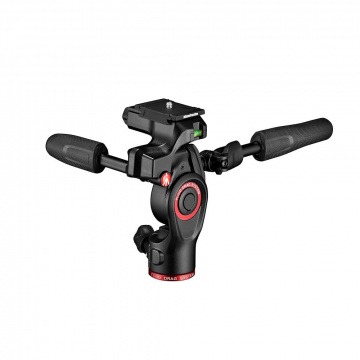
The MH01HY-3WUS is not the same use case as a simple ball head, a conventional spring-assisted three-way head or the much larger 526-1 fluid video head. It combines three independent axes and fixed fluid drag in a compact foldable format. That can be relevant when you want the head mechanism itself for both still and motion work, while accepting that no legs are included. A whole tripod kit with a fluid head is a separate purchase configuration, and a finder match for that option does not mean it includes this exact Befree head. The product image shows the standalone head and controls, not tripod legs or a camera. This is a source-based assessment: no physical mounting, plate fit, payload, fluid movement, balance, drift, vibration or stability test was performed. Confirm the exact suffix, actual lower mount, camera plate and package contents, and keep the 6 kg versus 15.4 lb disagreement visible until it is resolved.Key specifications
Key details at a glance
| Head supplied with tripod legs | No |
|---|---|
| Head type | Three-way head |
Use the exact model’s instructions for operating limits, supplied equipment and version differences.
Sources for this review
Sources for this assessment

Make the choice fit your whole camera setup
Start with your head, camera and lens, then use the published figures as screening limits rather than field-performance claims.