
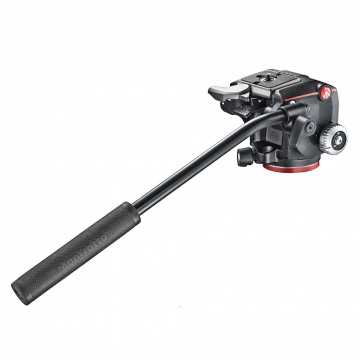
Your needs, this model
Does it fit your priorities?
Does the MHXPRO-2W come with tripod legs?
No. It is a standalone two-way fluid head, so legs or another support are separate. This finder link explores tripod legs without a head, not compatibility with this standalone head. Check the support thread and seating.
Explore this need in the finder →Are you looking for a complete tripod kit with a fluid video head?
MHXPRO-2W itself is only a fluid head. This link explores whole tripod kits supplied with a fluid head, not a kit that includes this exact standalone product.
Explore this need in the finder →Would you rather consider a tripod kit supplied with a three-way photo head?
MHXPRO-2W has pan and vertical tilt but no lateral-leveling axis listed. This finder link explores whole kits with a three-way head; it does not claim the models include MHXPRO-2W.
Explore this need in the finder →The Manfrotto MHXPRO-2W is a standalone fluid two-way camera head for someone who wants a pan handle, a 360-degree pan axis and a tilt control with two fluid settings. It is not a tripod kit, and its source documents disagree on both payload and several material and weight details. The distinctions below come from the exact model page, instructions and one exact U.S. retailer listing; no movement, balance, camera compatibility or stability test was performed.
Two axes and a selectable tilt setting
Manfrotto classifies the MHXPRO-2W as a video/fluid head. Its specifications list 360-degree pan, a vertical tilt range of -60 to +90 degrees, independent pan and tilt locks, fixed fluid drag on pan and two tilt-drag steps. A pan bar is included in the manufacturer’s specifications. The instruction manual says the bar is shipped detached and can be mounted on either side of the head, so plan to assemble and position it for your setup.
The selector changes the tilt-fluid setting rather than turning this into a three-way head. Manfrotto’s manual directs the user to choose X1 for a short lens and X2 for a long lens. That is the maker’s setup guidance, not evidence that a particular camera-and-lens combination will balance or move smoothly. The head has only pan and vertical tilt axes; it does not provide a separate lateral-leveling axis like a three-way photo head.
Fluid drag may be relevant when you want to make a deliberate pan or tilt rather than freely reposition a camera, but a specification cannot promise the result of a particular shot. Consider the weight and shape of the entire camera rig, the support beneath the head and how the handle will fit around other equipment. If you need counterbalance for a larger video setup, do not infer it from the word “fluid”: the exact U.S. listing reports no counterbalance.
Fit the support and camera sides separately
The exact manual describes a flat base with a 3/8-inch female thread and does not state its pitch. The U.S. B&H listing for the exact MHXPRO-2W identifies a 3/8-16 female base. Check the thread on your own support and the way its top plate seats; that seller’s detail is not a universal guarantee for every used head, adapter or tripod.
On the camera side, Manfrotto lists a 200PL-14 plate type, and B&H itemizes a 200PL-14 quick-release plate with a 1/4-20 screw in its stated package. The older manual describes a 200PL quick-release plate and a 1/4-inch male thread without specifying pitch. This is a useful distinction: the support-side 3/8-inch thread does not describe the camera-side screw. Check the actual package and the plate marking if you need an exact plate or screw.
The manual’s safety steps matter as much as the fitting names. It instructs users to make sure the plate is locked before working, hold the camera while releasing it, and avoid forcing the camera screw. Those are setup directions, not proof that this head fits every camera, scope, bracket or support.
Keep the published load values distinct
The 2013 Manfrotto manual and the current product overview both state 4 kg. The current formal specification table separately labels 5 kg as “Safety Payload UNI/PdR 105:2021”; the exact U.S. B&H item page also lists 5 kg. The manufacturer does not explain the difference between the older 4 kg statement and the newer named safety-payload field. They are not silently combined here, and neither is an independent field test or a universal working-load guarantee for the whole tripod system.
For a real setup, account for the head, camera, lens, plate and accessories together, then verify the lower support separately. A fluid head’s rating cannot certify the tripod beneath it or the behavior of an off-center rig. If a precise load threshold decides your purchase, ask Manfrotto to clarify which current model-specific limit applies to your use rather than relying on an unexplained number conflict.
Material and mass are also source-sensitive
The current manufacturer page calls the design aluminium in its overview, while its technical material field says technopolymer; the older manual describes polymer components. B&H’s exact-model description uses “polymer and fiberglass.” Those wordings do not establish a complete material breakdown, so this assessment does not claim a particular fiberglass content or a single all-metal/all-polymer construction.
Weight differs too: the manual’s cover lists 0.67 kg, the current manufacturer specification says 0.76 kg, and B&H rounds its listing to 0.8 kg; the page overview uses 0.7 kg. These are published source values, not new measurements. If travel mass matters, check the exact current manufacturer record and seller offer rather than assuming the rounded values are interchangeable.
What to check before choosing it
Confirm the exact MHXPRO-2W code, the flat-base interface and the supplied 200PL-14 plate in the offer. Verify the support’s thread and seating, and make sure the detachable pan handle can be positioned where you need it. If you need a three-axis leveling control, a ball head, a different plate system or a counterbalanced video head, compare those requirements directly; this two-way head should not be treated as a complete tripod or a substitute for a more specialized support. Read its exact manual for installation and release instructions before mounting equipment.
Key specifications
Key details at a glance
| Head supplied with tripod legs | No |
|---|---|
| Head type | Fluid video head |
Use the exact model’s instructions for operating limits, supplied equipment and version differences.
Sources for this review
Sources for this assessment

Make the choice fit your whole camera setup
Start with your head, camera and lens, then use the published figures as screening limits rather than field-performance claims.