
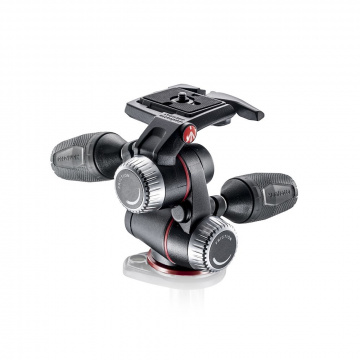
Your needs, this model
Does it fit your priorities?
Does MHXPRO-3W include tripod legs?
No. It is a standalone head; legs or another lower support are separate. The finder link explores tripod legs sold without a head, not compatibility with this head. Check the 3/8-inch support thread, seating and support rating.
Explore this need in the finder →Would a tripod kit with a three-way head serve your starting point?
This is the separate MHXPRO-3W head, not a complete kit. The finder link explores whole tripod kits supplied with a three-way head; it does not imply those kits include this standalone model.
Explore this need in the finder →Is fluid drag essential for your video pan and tilt?
Manfrotto describes MHXPRO-3W as a three-way head, not a fluid-drag head. The finder link explores tripod kits with a fluid video head; it is not a claim about results from this geared/separate-axis model.
Explore this need in the finder →Consider the Manfrotto MHXPRO-3W if you want a separate three-way camera head with retractable handles and axis-specific controls; it is not a tripod kit. The maker’s current materials describe independent pan and tilt locks, friction adjustment on two tilt axes and three bubble levels. This is a source-based assessment, not a hands-on test of movement, balance or stability.
Separate controls suit deliberate framing
Manfrotto calls this a three-way head. Its manual describes one handle for 360-degree pan and two for leveling and forward/back tilt; each tilt direction has a published range from -30 to +90 degrees. The product information lists friction control for the tilt and portrait axes, while the detailed specification table lists no pan or tilt drag. Those labels describe the published mechanism, not a promise about how a particular camera-and-lens rig will feel in use.
Separate axis controls give a photographer a different way to refine a composition from releasing one ball joint and moving the camera in several directions at once. That can be useful when you want to adjust one orientation while retaining the others, but a three-handle layout also takes more deliberate setup than a single-control head. Manfrotto’s page identifies a photo three-way head, not a fluid-damped video head. If smooth fluid pan-and-tilt drag is a requirement, verify that a specific head is described as fluid rather than relying on the “XPRO” family name.
Retractable handles reduce the stored footprint
The handles retract for storage and extend for operation. Manfrotto publishes a folded head size of 13 × 13.5 × 13.5 cm; that is the head’s stated folded size, not a complete tripod’s packing length. The official page lists 1 kg for the head and a 60 mm base diameter. These are maker values, not measurements made for this article. A compact head can still add a kilogram above the tripod legs, so consider the total support system rather than comparing head mass alone.
Check the two different attachment sides
The support-side interface is a 3/8-inch female thread according to the exact-model manual. The manual does not state a thread pitch. Confirm the pitch, seating surface and any anti-rotation arrangement on the particular tripod or other support before attaching the head; a nominally familiar diameter alone does not prove a secure combination.
On the camera side, Manfrotto’s current specification names a 200PL-14 plate type and a 1/4-inch screw, but it does not give the screw pitch in that field. The camera plate and support thread serve different jobs. Check the exact plate marking and the screw needed for your camera or bracket, and confirm the actual seller’s box if the plate matters. The U.S. model listing identifies MHXPRO-3W and UPC 719821364733, but does not itemize every package component.
Read the payload figures as an unresolved discrepancy
Manfrotto’s current page has two different payload statements: a feature says the head supports up to 8 kg, while its specification table labels 12 kg as “Safety Payload UNI/PdR 105:2021.” The exact-model manual also prints 8 kg. The sources do not explain how those numbers relate, so this assessment keeps their labels separate rather than selecting the larger one as a universal limit. Neither number is an independent load test or a stability guarantee for your camera, lens, plate and lower support together.
Use the exact instructions and confirm the whole setup, especially with off-center equipment. The head’s rating does not increase the capacity of the tripod legs beneath it, and a visible plate or bubble level cannot establish that a particular rig is balanced.
What to verify before choosing it
Match the full MHXPRO-3W code and the three-way head configuration, not just a similar-looking Manfrotto suffix. Confirm that you are buying a head alone and already have, or plan to buy, appropriate support legs. Check the mount pitch and plate marking against your actual hardware. If package contents, an exact load boundary or movement behavior is decisive, use the current model-specific instructions and ask the seller to identify the exact offer; do not assume a photo or a neighboring X-PRO model answers those questions.
Key specifications
Key details at a glance
| Head supplied with tripod legs | No |
|---|---|
| Head type | Three-way head |
Use the exact model’s instructions for operating limits, supplied equipment and version differences.
Sources for this review
Sources for this assessment

Make the choice fit your whole camera setup
Start with your head, camera and lens, then use the published figures as screening limits rather than field-performance claims.