
Your needs, this model
Does it fit your priorities?
What makes the aluminum GT XPRO different from the carbon sibling?
The exact MKBFRA4GTXP-BUS is the aluminum version, listed at 2 kg and 164 cm maximum; the carbon MKBFRC4GTXP-BUS is listed at 1.76 kg and 162 cm maximum. Both use the 496 ball head and the 90° column. The smaller published mass does not establish better stability.
Explore this need in the finder →Does its column actually move sideways, and what locks the legs?
The exact GT XPRO page and shared instructions document a sliding 90° center column that can sit horizontally. The legs use M-Lock twist locks, so this is distinct from the nearby Befree lever-lock models.
Explore this need in the finder →What do the published size figures tell me?
Manfrotto’s shared instructions list 164 cm maximum height and 2 kg mass; the exact U.S. B&H code listing gives 64.6 inches maximum, 3.5 inches minimum, 16.9 inches folded and 4.4 lb. The latter rounds to about 2 kg, but no column-down maximum was confirmed.
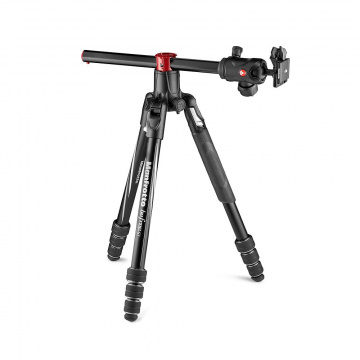
Explore this need in the finder →Manfrotto’s Befree GT XPRO aluminum kit is the heavier sibling to the carbon MKBFRC4GTXP-BUS, not a different head system. The exact -BUS code identifies an aluminum four-section travel tripod with an Advanced 496 center ball head, M-Lock twist legs, a 200PL-PRO plate and a 90-degree center-column mechanism. Its specification profile is a little taller on paper than the carbon sibling, while the listed fold is the same 43 cm.
The column is the unusual part
The GT XPRO’s sliding center column can be moved into a horizontal position. Manfrotto’s product description and shared instructions explain the side-column arrangement, so this is not a guess based on a reversed column or an illustrative photograph. It gives a second way to place a camera relative to the tripod footprint, potentially useful for overhead or close-up framing. It does not establish a specific working distance, camera clearance or stable load in that position; those depend on the camera, lens, head and how the legs are set.
When the column is used vertically, the tripod operates as a familiar compact travel support. That ability to change position is a genuine capability, but it comes with a setup choice: if you never need the horizontal mode, a simpler column may be less complexity than your routine requires.
Aluminum carry tradeoffs
This is a four-section aluminum model with M-Lock twist locks and three documented leg angles. The maker’s shared instruction sheet lists a 2 kg mass and 164 cm maximum height. B&H’s exact U.S. listing gives 4.4 lb, 64.6 inches maximum, 3.5 inches minimum and 16.9 inches folded; those values round to about 2 kg, 164 cm, 9 cm and 43 cm. The sources agree on the main carry figures after unit conversion, but the weight is for the kit rather than a measured pair of bare legs.
The carbon sibling is listed at 1.76 kg and 162 cm maximum. That is a small difference in published mass and maximum height, not evidence that one material is inherently steadier or a better choice for every camera. If your carry limit is strict, compare the complete kit mass and case length rather than choosing by material label alone. A maximum column-up height also does not promise that a tripod will frame at a particular eye level on uneven ground.
Head, plate and add-ons
The included head is a 496 center ball head. The product page names the 200PL-PRO plate and its Arca-type compatibility; it also lists exceptions for the 804RC2 and MH804-3W heads. Check the actual camera plate or cage you use, including any lens collar or long foot, instead of assuming every Arca-style item clamps identically. A ball head is suited to quick framing but is not a fluid video head; it does not provide a documented pan-and-tilt drag system for controlled camera moves.
The tripod’s Easy Link point supports adding accessories, and the manufacturer describes a dedicated carry bag. Confirm the precise -BUS suffix and the seller’s listed package. Do not substitute the similarly named carbon kit, an older -BH code or an aluminum kit with a different lock style.
What the figures do not say
The reviewed sources do not establish a column-down maximum height for this exact U.S. kit, so that number is left open. The shared instruction sheet has an older 10 kg table without the current standardized label, while the exact U.S. B&H page displays a 26.5 lb field. Their definitions are not resolved here, so neither value is used as a camera-specific working load or a stability claim. No camera-and-lens pairing, head feel, setup speed, wind performance or vibration was physically tested.
This is a documentation-based assessment. The exact product page supports the material, head arrangement, 90-degree column, locks and supplied interface; it cannot tell whether a specific seller’s tripod is complete or in good condition. For that, verify the model code, plate, head and bag in the actual offer.
Who should shortlist it
Choose the MKBFRA4GTXP-BUS for a compact aluminum kit that includes a 496 head and a real horizontal-column mode, particularly if a 164 cm maximum is more useful than the carbon sibling’s lower mass. Look elsewhere if you need a fluid video head, a separately confirmed column-down height, a more compact folded length than 43 cm, or a performance claim tied to a particular camera load. The key decision is not “aluminum versus carbon” in isolation; it is whether the documented column and included head justify the complete kit’s weight and carry dimensions for your own setup.
Key specifications
Key details at a glance
| Listed support or kit weight | 2 kg |
|---|---|
| Leg material | Aluminum |
| Maximum height (as listed) | 164 cm |
| Minimum height | 9 cm |
| Closed length | 43 cm |
| Leg sections | 4 |
| Leg-lock style | Twist locks |
| Head supplied with tripod legs | Yes |
| Head type | Ball head |
| Upper head attachment | 3/8-inch threaded platform beneath included 496 head |
| Carrying bag included | Yes |
| Easy Link accessory connector | Yes |
| Leg-angle positions | 22 / 54 / 89° |
Use the exact model’s instructions for operating limits, supplied equipment and version differences.
Sources for this review
Sources for this assessment

Make the choice fit your whole camera setup
Start with your head, camera and lens, then use the published figures as screening limits rather than field-performance claims.