
Your needs, this model
Does it fit your priorities?
Would the carbon Big kit keep the stated carry weight below 1.5 kg while retaining a ball head?
Manfrotto lists this exact kit at 1.4 kg with a ball head included; the nearby black aluminum Big kit is listed at 1.6 kg. The difference is 0.2 kg on paper, not a measured carry test.
Explore this need in the finder →Does the Big kit meet a 164 cm reach and 42 cm packed-length limit?
The exact model page lists a 164 cm maximum and 41.5 cm closed length; it lists 141 cm with the center column down, so the full-height figure requires extending that column.
Explore this need in the finder →What is actually included instead of a legs-only support?
The exact model is a ball-head kit with an Arca-type quick-release plate and padded bag; confirm the seller's condition and exact box before ordering.
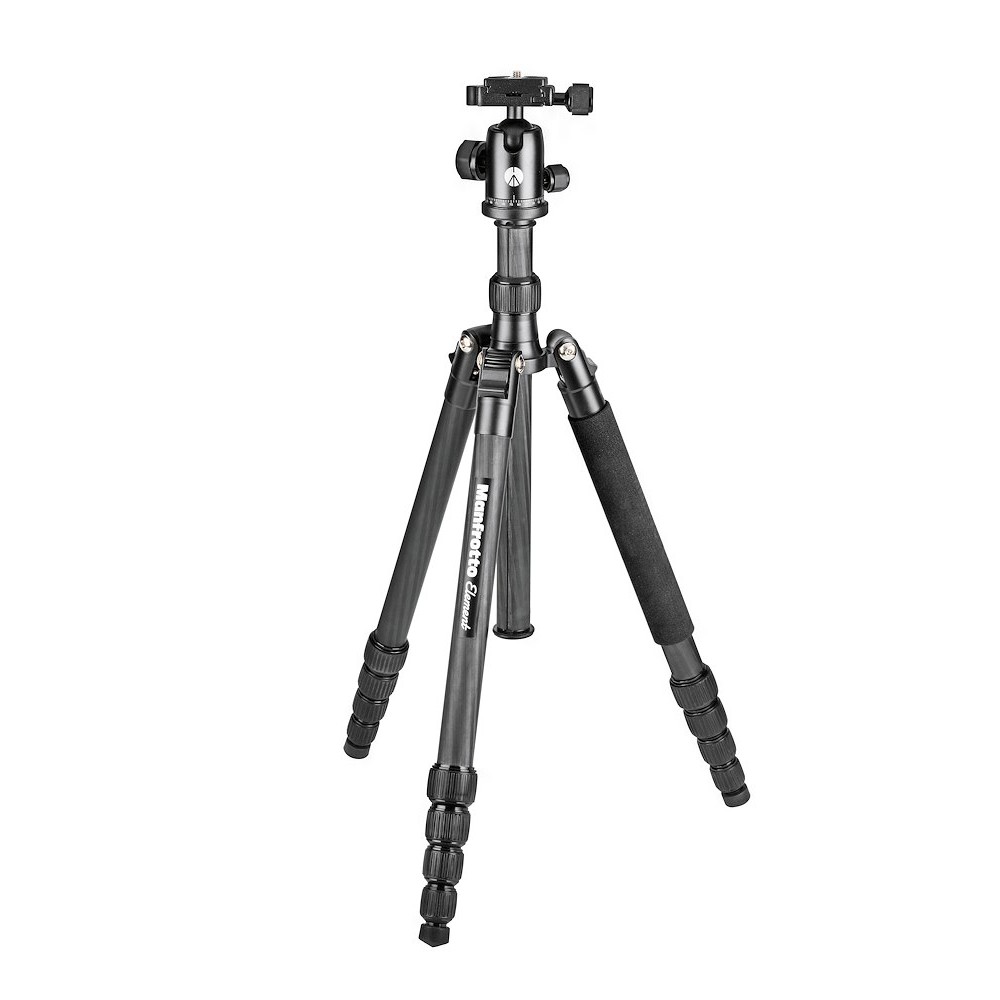
Explore this need in the finder →The MKELEB5CF-BH is the carbon-fiber version of Manfrotto's Element Traveller Big kit: a five-section travel tripod with a rapid center column, an aluminum ball head and a padded bag. The manufacturer lists the kit at 1.4 kg, with a 164 cm maximum height and a 41.5 cm folded length. Its aluminum Big sibling, MKELEB5BK-BH, is listed at 1.6 kg and 42 cm closed. That 200 g difference is a concrete reason to prefer the carbon legs if it matters in your carry plan; it is not evidence that this model has been field-tested as more stable, nor a claim about price.
Reach and travel size are different jobs
The catalogue gives this kit a 41 cm minimum height and a 164 cm maximum. The maximum with the center column down is 141 cm, so the taller figure depends on raising the column. If you routinely work near full extension, compare that use with the lower column-down height and your own camera-and-lens load rather than treating the headline height as the height of every setup. The listed folded length is 41.5 cm: compact beside a studio support, but long enough that a bag's tripod pocket or your carry-on dimensions still need checking.
There are five leg sections, three independent leg-angle positions and twist locks. A spring-loaded hook under the column is listed for adding ballast, and one detachable leg can be joined to the column as a full-size monopod. Those are useful choices to know about before packing, but this is still one physical tripod that must be reconfigured; a monopod conversion is not a second head or a substitute for a separate support. We have not timed the locks, loaded the hook or measured this kit's stability.
Carbon legs, aluminum head
The material choice refers to the legs. Manfrotto identifies the legs as carbon fiber and the included ball head as aluminum. The head has a separate panoramic lock and a 360-degree index, and its quick-release plate is described as Arca-type with a 1/4-inch camera screw. Check the dimensions and profile of your own plate or clamp before assuming that every third-party Arca-style accessory will fit; the label alone is not a universal compatibility guarantee. This kit is not legs-only: if you want to choose a different head, verify the top attachment and whether the exact package you are considering is actually the MKELEB5CF-BH.
The manufacturer publishes an 8 kg payload figure, and B&H's exact-code US listing reports 17.6 lb, a close unit-converted match. Those are product claims, not a test with your camera, lens, plate, wind exposure or ground surface. A long lens moved off-center can present a different practical demand from a compact camera even when both fall below a stated load. Treat the rating as a ceiling to check, not a promise that every setup will be satisfactory.
What the model does not answer
The exact pages identify a rapid telescoping column, but the sources reviewed for this assessment do not establish that it can swing into a horizontal position. The finder therefore does not count this kit as a documented horizontal-column option; if that movement is essential for copy work or overhead framing, select only a model whose source explicitly establishes the mechanism. The listed column hook is a different feature: it provides a place to add weight, not an articulated cross-arm.
The official photo confirms the carbon Big tripod and ball-head appearance, but it cannot show a safe load, lock wear, a particular camera fit or what a seller's box contains. There is no hands-on assessment here. The exact-code B&H page provides a US identity bridge but says that listing is no longer available, so it does not establish a current offer or condition. Before ordering any used or remaining stock, check the full model code, actual condition, included plate and bag, return terms and whether the seller's photos show the same configuration.
Who should keep it on the list?
Keep the MKELEB5CF-BH in consideration when you want a carbon-leg Big-format travel kit, value a published 1.4 kg weight, need the included ball head and expect the listed 164 cm maximum to be useful. Its best-documented compromise is straightforward: less listed kit weight than the black aluminum Big counterpart, but a 41.5 cm folded length and a column whose horizontal-position capability remains unverified here. If your hard limits are tighter than those dimensions, if you need a known horizontal column or a specific plate interface, do not fill in the gap from the family name or photograph. Confirm the exact assembly and seller package first.
Key specifications
Key details at a glance
| Listed support or kit weight | 1.4 kg |
|---|---|
| Leg material | Carbon fiber |
| Maximum height (as listed) | 164 cm |
| Maximum height, column down | 141 cm |
| Minimum height | 41 cm |
| Closed length | 41.5 cm |
| Leg sections | 5 |
| Leg-lock style | Twist locks |
| Head supplied with tripod legs | Yes |
| Head type | Ball head |
| Carrying bag included | Yes |
| Leg-angle positions | 21.5 / 54.5 / 83° |
Use the exact model’s instructions for operating limits, supplied equipment and version differences.
Sources for this review
Sources for this assessment

Make the choice fit your whole camera setup
Start with your head, camera and lens, then use the published figures as screening limits rather than field-performance claims.