
Your needs, this model
Does it fit your priorities?
What does the fourth leg section change in the 055 comparison?
Manfrotto lists the MT055CXPRO4 at 54 cm folded and 2.25 kg, while its three-section carbon MT055CXPRO3 is listed at 63 cm and 2.1 kg. The four-section version saves 9 cm of folded length on the published figures but adds 0.15 kg. Those figures do not establish a difference in stiffness or vibration behavior.
Explore this need in the finder →Can the center column be used for overhead or offset framing?
The manufacturer describes a 90-degree horizontal position, and its manual explains how to raise, rotate, re-seat and lock the column. Keep fingers clear when changing it back to vertical, select a compatible head and treat the off-center arrangement as a framing option—not a tested stability guarantee.
Explore this need in the finder →Does this exact MT055CXPRO4 include a head or bag?
The official catalogue distinguishes the standalone MT055CXPRO4 from the separate MK055CXPRO4-Q6T ball-head kit; the exact MT listing has a 3/8-inch upper screw and lists no carrying bag. Verify the seller's exact box contents because a regional offer can be rebundled.
Explore this need in the finder →Assessment at a glance
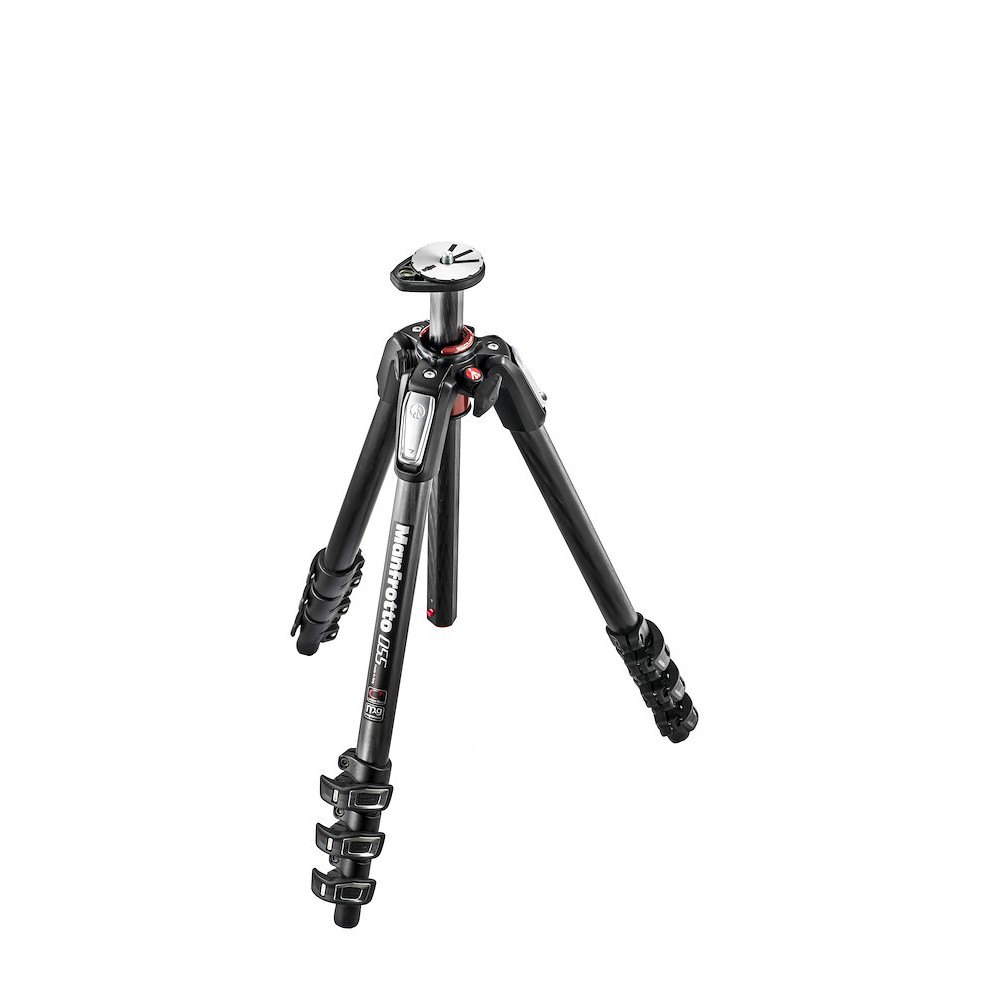
The MT055CXPRO4 is Manfrotto’s four-section carbon-fiber version of the 055 photo tripod with a column that can be used vertically or repositioned horizontally. Its distinguishing practical number is the manufacturer’s 54 cm closed length: the matching three-section carbon-fiber MT055CXPRO3 is listed at 63 cm. The trade is modestly more weight on paper—2.25 kg versus 2.1 kg—rather than a smaller, lighter tripod in every dimension. These are catalogue specifications, not measurements from a sample.
This is a source-led assessment, not a hands-on test.
Four sections, shorter storage length
Manfrotto lists four leg sections, a 170 cm maximum height with the column raised, 140 cm with it down, a 9 cm minimum height and a 54 cm folded length. The four-part layout makes this version easier to fit into a shorter storage space than the 63 cm three-section carbon-fiber MT055CXPRO3; it does not reduce the collapsed package to carry-on luggage size. A 54 cm tripod plus its head, plate and camera still needs a bag or case long enough for the assembled kit.
The extra section also changes the published weight comparison in a way worth noticing. MT055CXPRO4 is listed at 2.25 kg, while the three-section carbon model is listed at 2.1 kg. A buyer who values less packed length can favor this model; one who would rather save 150 grams and accepts a longer folded tripod can consider the three-section version. I would not turn those nominal figures into an unsupported claim about comparative rigidity, vibration damping, or setup speed. Manfrotto describes both as members of the same 055 family, but no independent comparative test is part of this assessment.
The listed maximum is the tripod height, not the height of your viewfinder. Add the chosen head and plate, then account for camera-body and eye-position geometry. If your hard minimum is more than 170 cm at the legs, this specification does not meet it; if the camera needs to sit near that height, a head can add height but the camera position and clearance still need checking.
The center column is the distinctive tool
The 055 column is not just a conventional extension. Manfrotto describes a 90-degree mechanism that can be returned from vertical to horizontal, allowing the camera to sit offset from the leg footprint or overhead for a flat-lay viewpoint. The shared manual gives a specific sequence: loosen the column knob, press the release while lifting the column until the red collars emerge, rotate it 90 degrees, slide it into the horizontal opening, and lock the knob. To return it upright, the manual warns to keep a hand clear of the moving column to avoid a pinch.
This is a framing capability, not a promise that a heavy camera is stable in every offset position. A wider or asymmetric camera setup changes where the load sits relative to the legs. Choose the head and plate for the camera and lens, spread and place the legs deliberately, and use the exact model’s instructions. Manfrotto lists a 20 kg Safety Payload under UNI/PdR 105:2021; that named figure should not be read as a recommended load for an extended horizontal column or as a guarantee against tipping or vibration.
Head, plate and carry package need a separate check
MT055CXPRO4 is the standalone MT-series tripod entry, not the separate MK055CXPRO4-Q6T ball-head kit in Manfrotto’s 055 collection. The standalone page lists a 3/8-inch screw at the top and no carrying bag. Its image shows the bare tripod platform; the manual explains how to mount a separately selected head using that screw and how to secure the head’s base with a small set screw. The head’s plate, quick-release system and controls therefore depend on what you pair with the legs.
That distinction matters if you are replacing a tripod rather than adding one to an existing system. Check the head’s mounting thread, the camera’s required plate, the way your head handles portrait orientation, and whether any kit listing actually names the head and plate. A store may bundle accessories under its own offer, so confirm the exact model and box contents rather than assuming the manufacturer’s standalone listing describes every seller package. The 2.25 kg figure is the legs alone, not the head, bag, camera or lens.
Other relevant features include a rotating bubble level, four independent leg-angle positions and an Easy Link connector for an accessory arm. The manual notes a hook for an optional strap, a counterweight that is not supplied and a last leg position near floor level; accessories still need compatibility and carry planning.
Who should keep comparing?
MT055CXPRO4 is worth comparing if a horizontal center column is an essential feature and a shorter folded length is more useful to you than the lightest listed weight among these two carbon-fiber 055 legs. The 54 cm figure is the strongest reason to look at the four-section model; the 2.25 kg weight and no-included-bag listing make it less compelling if your first priority is a low-burden walking kit. For shorter storage with a complete head already selected, compare the exact standalone SKU with the distinct head kits instead of treating their packages as interchangeable.
Before buying, verify that the offer is MT055CXPRO4 rather than the three-section MT055CXPRO3, an aluminum 055, or the MK055CXPRO4-Q6T bundle. Confirm regional contents, selected-head compatibility and current safety notices, then read the manual for column conversion and leg setup. The model’s published dimensions can narrow a shortlist; they cannot settle whether a particular camera, lens, surface, wind exposure and offset setup will be steady.
Manfrotto’s exact MT055CXPRO4 product page · Manfrotto’s shared 055/190 instruction manual
Key specifications
Key details at a glance
| Listed support or kit weight | 2.25 kg |
|---|---|
| Leg material | Carbon fiber |
| Maximum height (as listed) | 170 cm |
| Maximum height, column down | 140 cm |
| Minimum height | 9 cm |
| Closed length | 54 cm |
| Leg sections | 4 |
| Leg-lock style | Flip locks |
| Head supplied with tripod legs | No |
| Upper head attachment | 3/8-inch screw attachment |
| Carrying bag included | No |
| Easy Link accessory connector | Yes |
| Manufacturer safety-payload figure (UNI/PdR 105:2021) | 20 kg |
| Leg-angle positions | 25 / 46 / 66 / 88° |
Use the exact model’s instructions for operating limits, supplied equipment and version differences.
Sources for this review
Sources for this assessment
- 055 Carbon Fiber 4-Section Tripod with Horizontal Column — MT055CXPRO4
- Manfrotto Tripods & Monopods catalogue, 055 collection filter
- Manfrotto instruction manual for MT055CXPRO3, MT055CXPRO4, MT055XPRO3 and named MT190 models
- 055 Carbon Fiber 3-Section Tripod with Horizontal Column — MT055CXPRO3
- 055 Aluminum 3-Section Tripod with Horizontal Column — MT055XPRO3
Make the choice fit your whole camera setup
Start with your head, camera and lens, then use the published figures as screening limits rather than field-performance claims.