
Your needs, this model
Does it fit your priorities?
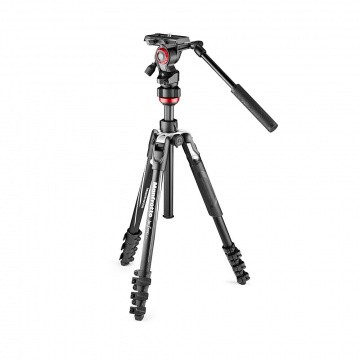
What makes MVKBFRL-LIVEUS the lever-lock Befree Live?
This exact aluminum kit uses the QPL Travel lever mechanism, while MVKBFRT-LIVEUS is the aluminum M-lock twist version and MVKBFRTC-LIVEUS is the carbon twist version. All are distinct exact codes with a supplied fluid head.
Explore this need in the finder →Does the lever version reach 151 cm?
The manufacturer lists a 151 cm maximum with the rapid center column extended and 130 cm with it down. These are support heights, not camera viewfinder heights, and its column is not documented as horizontally positionable.
Explore this need in the finder →Does this package fit a 40 cm storage limit?
Manfrotto lists 40 cm closed length. Verify the full folded setup and case with pan bar, plate and any accessories; product length alone does not guarantee a particular bag fits.
Explore this need in the finder →The Manfrotto MVKBFRL-LIVEUS is the aluminum lever-lock version of the Befree Live travel video tripod kit. It combines four-section legs, a rapid center column and the Befree Live fluid head with pan bar, 501PL sliding plate and carrying bag. Its published 1.75 kg mass is the highest of the three current Befree Live kits compared here, while its 151 cm listed maximum is one centimeter taller. This is an evidence-led product assessment, not a claim of hands-on operation or measured motion quality.
Why choose the lever-lock configuration
The defining difference is Manfrotto’s QPL Travel lever lock. The maker describes the lighter travel mechanism as bringing lever operation to a compact tripod. A lever offers a visible open/closed position and may be easier for some operators to inspect quickly; those are practical considerations to assess against personal preference, not proof that it deploys faster than the twist-lock siblings. In a bag, protruding levers can also be a consideration, so check the folded assembly against the case you intend to use.
The legs have four sections and three selectable angles at 22°, 54° and 89°. Manfrotto lists 40 cm both as minimum working height and closed length, with a 151 cm maximum when the rapid center column is extended and 130 cm with the column down. The center column is a vertical extension, not a horizontal-position mechanism. If your use depends on putting the camera off to one side of the tripod apex, this configuration does not meet that requirement as documented.
Included head and compatibility checks
MVKBFRL-LIVEUS is a kit with a fluid video head rather than headless legs. The manufacturer describes fluid cartridges on pan and tilt, independent movement locks, a sliding video plate and a pan bar. The supplied 501PL plate and included carrying bag are package-specific. Check the plate against any existing quick-release gear; plate systems are not interchangeable merely because they are all called sliding video plates.
The maker lists a 4 kg Safety Payload UNI/PdR 105:2021 value for the complete configuration. This should not be treated as a tested rig limit by this review or as a substitute for balancing instructions. Total payload alone does not tell you where a long lens or monitor places the center of gravity, and the fluid head’s own operating guidance remains important. The legs use a 40 mm upper disc, not the 75 mm bowl supplied on Manfrotto’s larger video tripod legs. If you need a conventional 75 mm half-ball interface, verify fit before purchase rather than assuming an adapter is included.
Travel package with real compromises
At 1.75 kg and 40 cm closed, the lever kit is still designed to travel, but it is heavier than the carbon-fiber twist version (1.38 kg) and aluminum twist version (1.64 kg). The extra 0.11 kg over the aluminum twist package buys a different lock mechanism, not a documented payload increase; all three are listed at 4 kg. The 151 cm maximum is slightly taller than the siblings’ 150 cm figure, while the column-down maximum is 130 cm. Those small differences can matter to a precise packing or height constraint but do not establish a noticeable real-world performance advantage.
The Easy Link attachment point allows a compatible accessory to be added at the spider. It does not turn the tripod into a larger cinema platform or guarantee clearance for a light or monitor on every setup. Check the full assembly when folded, including the pan bar, plate and bag, and follow the maker’s guidance for opening and closing the levers.
Who should shortlist it
This model is worth considering when a compact fluid-head video kit is more useful than separate legs and head, aluminum is acceptable, and lever locks are your preferred leg operation. Choose the aluminum twist sibling if you want the same general kit concept with M-lock twist legs and a slightly lower published mass. Choose the carbon twist version if mass matters most and the twist mechanism suits you. The lever version’s 151 cm maximum is not a substitute for checking camera-eye position, and none of these three packages documents a horizontally positionable center column.
Before buying, verify the complete MVKBFRL-LIVEUS code, 501PL plate, pan bar, fluid head and bag contents; compare the assembled camera rig with the head’s instructions; and confirm the folded dimensions fit your travel case. The exact code matters because other Befree models use different materials, heads and lock types while retaining a similar family name.
Sources: Manfrotto MVKBFRL-LIVEUS; Adorama exact-code MVKBFRL-LIVEUS listing.
Key specifications
Key details at a glance
| Listed support or kit weight | 1.75 kg |
|---|---|
| Leg material | Aluminum |
| Maximum height (as listed) | 151 cm |
| Closed length | 40 cm |
| Leg sections | 4 |
| Leg-lock style | Flip locks |
| Head supplied with tripod legs | Yes |
| Head type | Fluid video head |
| Carrying bag included | Yes |
| Easy Link accessory connector | Yes |
| Manufacturer safety-payload figure (UNI/PdR 105:2021) | 4 kg |
Use the exact model’s instructions for operating limits, supplied equipment and version differences.
Sources for this review
Sources for this assessment

Make the choice fit your whole camera setup
Start with your head, camera and lens, then use the published figures as screening limits rather than field-performance claims.