
Your needs, this model
Does it fit your priorities?
How does MVKBFRT-LIVEUS differ from the carbon Befree Live?
Both are four-section twist-lock kits with a fluid head, 501PL plate, pan bar, bag and a 150 cm listed maximum. The carbon code MVKBFRTC-LIVEUS is 1.38 kg/41 cm folded; this aluminum code is 1.64 kg/40 cm folded.
Explore this need in the finder →Is the supplied Befree Live head adjustable for drag?
The manufacturer lists fixed fluid cartridges for pan and tilt with separate locks. If variable drag is a hard requirement, this exact kit should not be represented as having it; check another head and verify its full package code.
Explore this need in the finder →Can I fit this kit into a case capped at 40 cm?
Manfrotto lists 40 cm closed length for MVKBFRT-LIVEUS. Check the case with the pan bar, plate and accessories as carried; the published tripod length alone does not prove a particular bag fit.
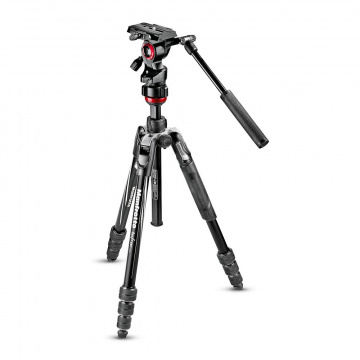
Explore this need in the finder →Manfrotto’s MVKBFRT-LIVEUS pairs four-section aluminum twist-lock legs with the Befree Live fluid video head. It is the middle-weight option between the lighter carbon-fiber MVKBFRTC-LIVEUS and the aluminum lever-lock MVKBFRL-LIVEUS. Manfrotto lists a 1.64 kg kit weight, 150 cm maximum height, 40 cm minimum and 40 cm folded length. This assessment reads those published specifications and package details; it does not claim hands-on setup or video testing.
What is in the exact twist-lock package
The manufacturer identifies this as a video tripod kit, not legs alone. The package is described with the Befree Live fluid head, pan bar, sliding 501PL plate and carrying bag. The head provides fixed fluid drag for pan and tilt and separate on/off locks for the two movements. That is a straightforward travel-video arrangement, but it is not an adjustable drag system. If you want to fine-tune resistance to match a heavier camera or slower movement, confirm the supplied head’s design before choosing the kit.
The 501PL plate is a meaningful compatibility check. “Quick-release plate” does not mean it matches every head or cage, and the plate’s orientation and safety features should be checked against your camera base and cable layout. The package’s 4 kg Safety Payload UNI/PdR 105:2021 rating is Manfrotto’s published figure for this model. It is not a field test and does not replace the head’s balance instructions. A camera body alone can weigh less than a complete rig with lens, battery and monitor.
Twist locks and travel dimensions
This aluminum version uses Manfrotto’s M-lock twist mechanism, rather than the QPL travel lever on MVKBFRL-LIVEUS. The maker describes the M-lock as a compact system without protruding parts, allowing the legs to close neatly around the head. Whether that style feels faster or more comfortable than a lever is personal; it is a mechanism distinction, not a measured setup-speed advantage. The model uses four leg sections and has three independent leg-angle positions at 22°, 54° and 89°.
The supplied rapid center column extends to the listed 150 cm maximum; with the column down the maker lists 129 cm. The minimum height and closed length are both 40 cm. The center column is not described as horizontally positionable, so a need for lateral column placement should be screened separately rather than inferred from the adjustable leg angles. At 1.64 kg including the kit components, it is portable in comparison with larger twin-leg video supports, but it is not the lightest Befree Live configuration.
Useful features and limitations
Manfrotto specifies an Easy Link accessory point, a rapid column, an included bag and a 40 mm upper disc. Those details help distinguish it from the headless bowl tripods in the same source catalogue. The legs do not offer a 75 mm video bowl; this is a matched small head-and-tripod travel package. If you plan to transfer a larger 75 mm half-ball head from existing video sticks, do not assume it mounts directly to this spider.
The 40 cm closed length is useful for packed travel, though the real bag measurement should include the pan bar and whatever accessories you keep attached. The head and legs are compact, which is convenient, but the published maximum is 150 cm and the maker’s column-down maximum is shorter. If your work requires a taller support or a separately specified horizontal column, compare another model rather than relying on camera-eye height assumptions.
How it compares with the other Befree Live choices
Choose this version if you prefer aluminum and a flush twist lock. The carbon model reduces listed mass by 0.26 kg but uses the same general twist approach; the aluminum lever version adds 0.11 kg over this twist kit and uses a different lock system. These are exact-code package differences, not a ranking of image quality or long-term durability. A product photo can help identify which leg material and lock style is shown, but confirm the offer’s model code because the versions share a family name and similar silhouette.
Before checkout, confirm MVKBFRT-LIVEUS, the included fluid head, 501PL plate, pan bar and bag. Check your camera’s assembled weight and balance against the supplied head, verify that the plate matches your rig, and decide whether 150 cm with the column extended is sufficient. If you specifically need the lever mechanism or lower total weight, the adjacent Befree variants are distinct options rather than cosmetic finishes.
Sources: Manfrotto MVKBFRT-LIVEUS; Adorama exact-code MVKBFRT-LIVEUS listing.
Key specifications
Key details at a glance
| Listed support or kit weight | 1.64 kg |
|---|---|
| Leg material | Aluminum |
| Maximum height (as listed) | 150 cm |
| Closed length | 40 cm |
| Leg sections | 4 |
| Leg-lock style | Twist locks |
| Head supplied with tripod legs | Yes |
| Head type | Fluid video head |
| Carrying bag included | Yes |
| Easy Link accessory connector | Yes |
| Manufacturer safety-payload figure (UNI/PdR 105:2021) | 4 kg |
Use the exact model’s instructions for operating limits, supplied equipment and version differences.
Sources for this review
Sources for this assessment

Make the choice fit your whole camera setup
Start with your head, camera and lens, then use the published figures as screening limits rather than field-performance claims.