
Your needs, this model
Does it fit your priorities?
Does the MVTTWINMCUS include a video head?
No head is listed. The manufacturer and exact-MFR US listing describe legs with a 100 mm bowl and supplied 75 mm adapter, so choose one compatible head separately and confirm its half-ball size before mounting.
Explore this need in the finder →What makes the MCUS different from Manfrotto's carbon twin-leg ground-spreader model?
The MVTTWINMCUS supplies a removable mid-level spreader and has a listed minimum height of 58.5 cm; the MVTTWINGCUS supplies the ground-level spreader and lists a lower 33.5 cm minimum. The latter is not a different configuration of the MCUS: the spreader arrangement and working range are distinct.
Explore this need in the finder →Can the 75 mm adapter turn the tripod into a ready-to-shoot kit?
No. It converts the 100 mm bowl interface for a compatible 75 mm half-ball head; the head, pan bar and camera plate are separate. A flat-base head needs a separately sourced compatible half-ball adapter, and the instructions show the supplied 75 mm bowl adapter secured with three screws.
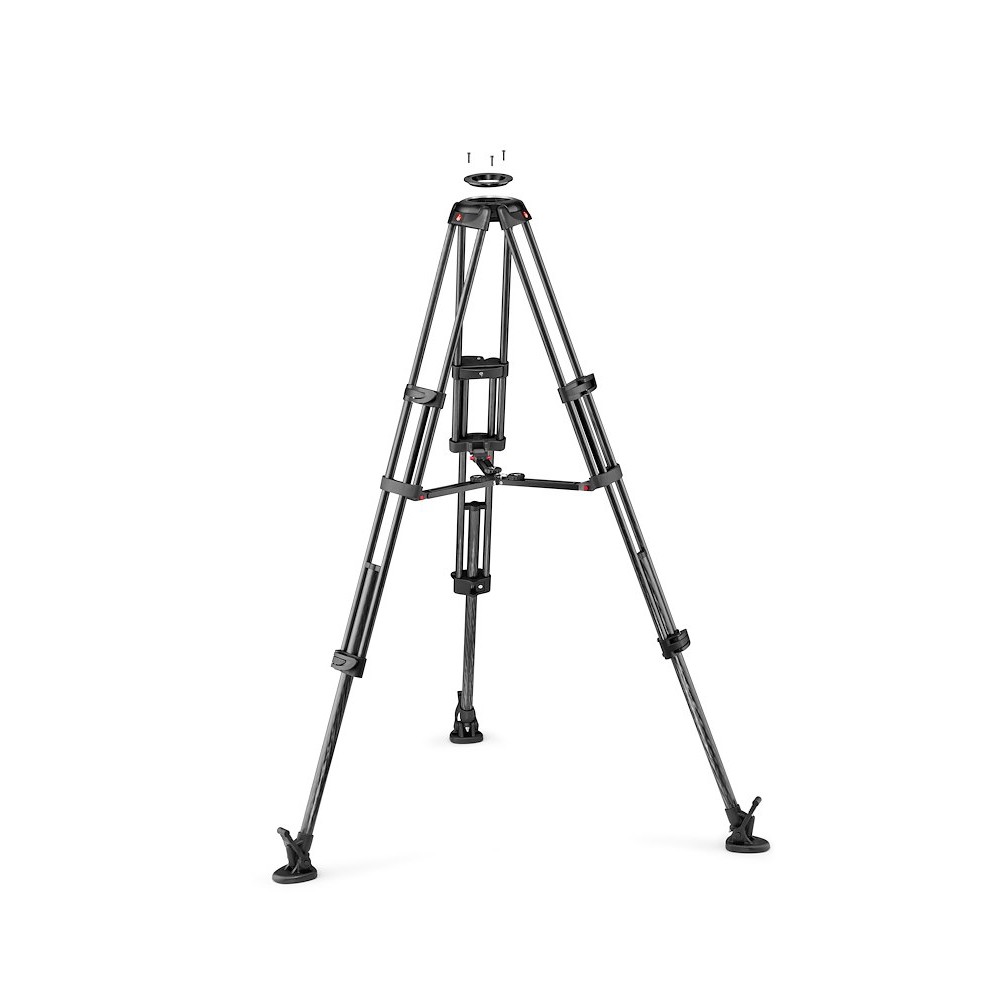
Explore this need in the finder →The Manfrotto MVTTWINMCUS is a set of carbon-fiber twin video legs, not a complete camera-ready tripod kit. The most useful package distinction is its adjustable mid-level spreader: it links the legs above the floor, while a separate 75 mm bowl adapter lets the 100 mm platform accept a compatible smaller half-ball head. Manfrotto lists no head or carrying bag with these legs. That matters more than the phrase “professional video tripod,” because the head, plate, pan bar and bag you may already own—or still need to buy—change both compatibility and the carried system.
Choose a head around the bowl, not the product name
The tripod's top is a 100 mm bowl. The manufacturer says the package includes an aluminum adapter that converts the bowl to 75 mm, and the instructions show attaching this piece with three screws. If your head has a 100 mm half-ball, that adapter is not the intended route; if it has a 75 mm half-ball, confirm that the supplied adapter is in the exact box and fits the head. A flat-base head does not sit in this bowl just because a 75 mm part is supplied: the manual calls for an additional compatible half-ball adapter for that conversion.
There is no head, camera plate or pan bar listed for the standalone MVTTWINMCUS. Do not confuse it with a 502X kit such as MVK502XTWINMA, which is a different SKU with a fluid head and its own mounting details. The simple test before buying is to write down your head's base interface, bowl size and plate, then match those against the leg package and the actual contents being offered. The 100-to-75 adapter is an interface part, not a substitute for a video head.
The mid-level spreader is the defining setup choice
The supplied telescoping spreader sits partway up the legs and can be adjusted to set the footprint. Manfrotto describes it as removable and compatible with the separately sold 165MV ground spreader as an alternate. The current package is not a ground-spreader kit, so a buyer planning a low, floor-resting brace should distinguish the accessory from the included mid-level piece. The manufacturer lists a 58.5 cm minimum working height with this configuration; its 153 cm maximum is a published tripod figure, not camera-eye height after a head, plate and camera are added.
Manfrotto lists three leg sections, flip locks, twin spikes and rubber overshoes. Its manual explains how to remove the shoes to use the spikes outdoors and calls for periodic checks that the locks hold. These are concrete setup details, not proof that the tripod is equally suitable on every stair, floor or patch of ground. A head must still be leveled, the spreader arms set appropriately and the feet planted according to the instructions. The source page does not give this exact US suffix model a numerical leg-angle range, so I would not borrow one from the aluminum mid-level version.
Carbon fiber here means a lighter leg set, not a tested rig
The exact manufacturer page lists 3.0 kg for the legs, 69 cm closed length and a 20 kg Safety Payload UNI/PdR 105:2021 figure. B&H's exact-MFR US page agrees on those values and names the same mid-level-spreader package. The aluminum MVTTWINMAUS is a useful close comparison: it also folds to 69 cm and reaches 153 cm, but its manufacturer-listed mass is 3.3 kg and safety-payload figure is 25 kg. Those catalog values describe separate leg configurations; they do not tell you which assembled rig will show less movement, nor do they establish camera/head compatibility by themselves.
The 3.0 kg figure excludes a separately chosen head and does not include your camera, lens, accessories or a case. The manufacturer says no carrying bag is supplied. Budget the complete setup before treating this as a carry solution, especially if you need a sizeable fluid head or an alternate spreader. The 20 kg number is a published rating, not an invitation to load the tripod to that figure in a raised or off-center arrangement.
Who should compare it—and what remains unknown
The MVTTWINMCUS makes sense to compare when you specifically want carbon twin legs with a mid-level spreader, a 100 mm bowl and a documented path to a 75 mm half-ball head. If you need a ground-level spreader out of the box, compare the separate carbon MVTTWINGCUS; if you need an included 502X fluid head and its plate, compare a full head-and-legs kit rather than treating these bare legs as equivalent. The aluminum MVTTWINMAUS supplies the same broad mid-level workflow with different listed construction and rating fields.
No hands-on setup, footage, payload, vibration or durability test was conducted for this review. The public evidence also does not establish how a particular head, camera and lens will behave when the legs are fully extended, or whether a seller's package includes any added item beyond the specified legs, adapter and feet. Check the exact MFR code, head half-ball, plate, spreader, feet and seller condition before purchasing.
Sources checked 30 October 2026: Manfrotto's exact MVTTWINMCUS page; the MVTTWINMC/MVTTWINGC instructions; and B&H's exact-MFR US listing. Manufacturer specifications and retailer-listed package contents are not our own tests.
Key specifications
Key details at a glance
| Listed support or kit weight | 3 kg |
|---|---|
| Leg material | Carbon fiber |
| Maximum height (as listed) | 153 cm |
| Closed length | 69 cm |
| Leg sections | 3 |
| Leg-lock style | Flip locks |
| Head supplied with tripod legs | No |
| Spreader position | Mid level |
| Carrying bag included | No |
| Manufacturer safety-payload figure (UNI/PdR 105:2021) | 20 kg |
Use the exact model’s instructions for operating limits, supplied equipment and version differences.
Sources for this review
Sources for this assessment
- CF Twin leg with middle spreader video tripod 100/75mm bowl - MVTTWINMCUS
- Manfrotto Carbon Fiber Twin Leg Video Tripod Legs with Mid-Level Spreader, MFR #MVTTWINMCUS
- Instructions MVTTWINMC / MVTTWINGC
- Exact-model Manfrotto MVTTWINMCUS image
- Manfrotto current tripods and monopods directory, page-one exact card

Make the choice fit your whole camera setup
Start with your head, camera and lens, then use the published figures as screening limits rather than field-performance claims.