
Your needs, this model
Does it fit your priorities?
Does the exact FGP18A package include a camera head, and what mount does it use?
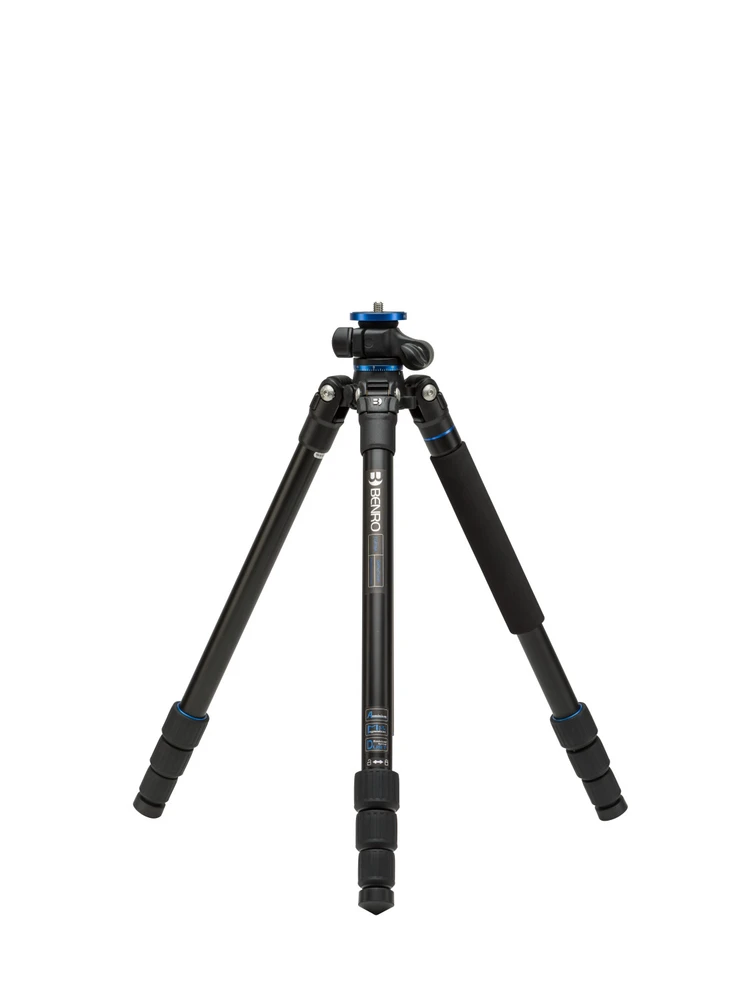
Benro labels the FGP18A 'Tripod Only' and specifies a standard 3/8-16 top-plate screw; B&H's exact-MFR page lists a fixed 3/8-16 platform and names the tripod, three spikes and case, not a head. The photographed tilt joint is part of the column assembly, not a ball head. Select the head and camera plate separately, then verify the head-base thread, clamp, camera or cage fit and exact seller box.
Explore this need in the finder →Can the FGP18A center column be positioned horizontally?
Yes. Benro describes the exact FGP18A center column as a lateral arm that tilts horizontally and locks in different positions; B&H independently lists 90-degree lateral support. That confirms a documented positioning mode, not off-axis stiffness, safe payload, clearance or performance. Balance and inspect the complete separately headed camera setup before relying on it.
Explore this need in the finder →Will the FGP18A meet a 154 cm height floor, 46 cm folded-length ceiling and 1.6 kg tripod-weight cap?
Benro's exact page lists 60.6 inches maximum, 18.1 inches closed and 1.59 kg product weight; B&H gives corresponding rounded values of 154 cm, 46 cm and 1.6 kg. On the finder's whole-centimeter/0.1 kg steps, the 154 cm, 46 cm and 1.6 kg limits admit the documented maker fields, while a 155 cm height floor, 45 cm fold ceiling or 1.5 kg weight cap rejects this model. These are product listing limits; they are not camera-eye height, bag fit, total system weight or measured performance. Amazon's separate 50 cm generic Item Length is not identified as a folded length.
Explore this need in the finder →Benro’s FGP18A is a Series 1 SystemGo Plus tripod-only configuration: aluminum four-section legs, sealed twist locks, a reverse-folding layout and a center column that can tilt sideways. Its unusual strength is flexibility of placement; its tradeoff is that the head is separate and the reported off-axis setup has not been performance-tested here.
Start with the exact tripod-only code
The Benro USA page identifies the FGP18A as “Tripod Only” and specifies a 3/8-16 top-plate screw. B&H’s exact-MFR listing also names FGP18A and describes a fixed platform with a 3/8-16 screw; its box list names the tripod, spiked feet and case, not a camera head. The joint visible at the top of the manufacturer image belongs to the center-column mechanism. It is not a supplied ball head. Choose a head and camera-side plate separately, then check base-thread fit, clamp compatibility and clearance for the actual camera, cage and lens. A matching screw is only one part of that chain.
This configuration distinction matters because the wider SystemGo line includes different parts and kits. Use the exact FGP18A code rather than a family photo or “Go Plus” wording, and confirm the seller’s box before ordering if the case or feet matter. The Amazon US page observed for the same code lists a tripod with a 180-degree column, padded case, spikes and tools as included components. That is a listing observation, not a guarantee that every current or used seller package is complete or in the same condition.
What the sideways column changes
Benro describes a lateral arm that can tilt horizontally and lock at different positions; B&H independently lists 90-degree lateral support. This gives the FGP18A a documented way to move the camera platform away from the leg apex. That can be useful when a close-up framing task needs a different camera position than the usual vertical column, or when straight-down composition is otherwise awkward. It changes where the head can be placed without replacing the tripod with a separate horizontal support arm.
The mechanism is an option for composition, not a promise of stability. A camera and lens hanging out to one side changes the balance of the whole setup. Neither the 22 lb published load rating nor the “horizontal” description establishes a safe off-center load, resistance to wind, vibration behaviour or clearance for a particular lens. I did not test the joint, load it, measure vibration or handle this model. Balance the complete rig, keep the leg footprint appropriate to the arrangement, secure every lock, and follow the product instructions. If your task requires a defined lateral load rating or repeatable precision positioning, the available evidence here does not settle that requirement.
Reach, fold and product weight
Benro lists a 60.6-inch maximum, 14.6-inch minimum and 18.1-inch closed length; B&H reports corresponding rounded metric figures of 154 cm maximum, 37 cm minimum and 46 cm closed. B&H separately gives up to 126 cm with the center column down. These are tripod support figures, not camera-eye height: a separately selected head, camera plate, body and the photographer’s position all affect the final viewfinder location. The column-down height is also a different configuration from the overall maximum.
The maker’s more precise tripod weight is 1.59 kg; B&H rounds it to 1.6 kg. For a strict finder limit, the more precise maker value is why 1.6 kg passes but 1.5 kg does not. Neither number includes a separately chosen head, camera, lens or personal bag unless an exact seller package says otherwise. Benro calls the FGP18A 18.1 inches closed and B&H lists 46 cm closed; Amazon’s product details show “Item Length” as 50 cm without specifying a folded measurement. I do not treat those differently labelled fields as the same condition. If a bag or storage slot is tight, verify the actual folded tripod and case opening rather than assuming a catalog length proves fit.
Series 1 beside the FGP28A
The reviewed FGP28A is the larger Series 2 aluminum, tripod-only counterpart. Benro lists a 65.2-inch maximum, with the exact-MFR retailer pairing it with 165.6 cm; its closed length is 49.5 cm and weight 1.92 kg. The FGP18A’s corresponding figures are 154 cm, 46 cm and 1.59 kg. Benro and B&H report 10 kg for the FGP18A, versus a 30 lb maker statement and a 14 kg B&H field for the FGP28A. Both have a lateral center-column design and both require a separate head, but the FGP28A is taller and has a higher published payload while also being longer and heavier. These are specification differences, not a ranking or a real-world performance comparison.
Pick the smaller FGP18A when its listed reach and mass fit the task and the compact folded figure is useful. Consider the FGP28A if its extra listed height matters more than its added length and weight. Do not assume Series 2 is automatically the better fit, or that the FGP18A’s lower number implies better portability for a full kit: the separate head and the rest of the camera system still count.
Twist locks, reverse folding and a second mode
The four leg sections use sealed twist locks, and the legs reverse-fold around the center column for transport. Benro says the lock seals help resist dust and moisture; that wording is not a waterproof rating, a grit test or evidence about lock life. Its product page and B&H package list identify a carrying case and spiked feet. Use spikes only where they suit the surface and are permitted, and verify exactly what is in the offered box. The supplied feet do not tell us how the tripod will perform on a particular floor, slope or soft substrate.
Benro also describes joining a marked leg to the center column to form a monopod. That is a distinct reassembled mode, not an extra leg or a simultaneous second tripod configuration. The matcher and height discussion here use the three-leg tripod plan; do not carry over tripod height, load or stability claims to the converted monopod unless a source documents that exact setup. For practical setup questions, see the guide to horizontal columns and close-up work and the guide to folded length and total carry weight.
What remains to confirm
The Benro USA manual index inspected for this assessment did not list an FGP18A or SystemGo Plus manual entry; that is a limitation of the index, not proof no manual exists elsewhere, and no sibling model’s procedure is substituted. Exact model sources document the basic arrangement and headline specifications, but they do not establish the camera/head combination, the real folded length of a particular seller’s assembly, a bag fit, an off-axis operating limit or current offer condition. Benro’s 22 lb and B&H’s 22 lb / 10 kg are published ratings, not an independent load or stability test. This review is a source-based comparison, not hands-on use, ownership, measurement or a field trial.
Key specifications
Key details at a glance
| Listed support or kit weight | 1.59 kg |
|---|---|
| Leg material | Aluminum |
| Maximum height (as listed) | 154 cm |
| Maximum height, column down | 126 cm |
| Minimum height | 37.1 cm |
| Closed length | 46 cm |
| Leg sections | 4 |
| Leg-lock style | Twist locks |
| Head supplied with tripod legs | No |
Use the exact model’s instructions for operating limits, supplied equipment and version differences.
Sources for this review
Sources for this assessment
- Benro USA Photo Tripods page 5, FGP18A card 8 of 12
- Benro USA exact FGP18A SystemGo Plus tripod-only product page
- B&H exact-MFR FGP18A US tripod listing, browser-rendered field observation
- Benro USA current User Manuals index, exact FGP18A applicability check
- Exact Benro USA FGP18A product-page-associated main image
Make the choice fit your whole camera setup
Start with your head, camera and lens, then use the published figures as screening limits rather than field-performance claims.